

Medellín has a population of more than 4 million inhabitants in its metropolitan area and is an example of sustainable mobility worldwide. In 2024 it was considered the eighth city with the best public transportation in the world according to Conde Nast Traveler magazine, being the only Spanish-speaking city in the Top 10. The fundamental pillar in these last decades of the significant progress of the capital of Antioquia in these rankings of urban mobility is its Metrocable, the pioneering urban funicular system inaugurated in 2004. This network became the first aerial cable for urban passenger transportation in the world. The project broke many mobility paradigms and became a worldwide example of sustainable and inclusive mobility. The orography of Medellín, surrounded by hills, made communication between the valleys and the center very complicated. Thanks to the Metrocable network, travel time was significantly reduced from 90 minutes to 30 minutes on average. In addition, new services and businesses were created, and a significant decrease in violence rates was observed. The cable car network has also served as an important element of cohesion and to eliminate many of the social barriers that conditioned the lives of the 240,000 inhabitants of Medellín’s Colonias 1 and 2. Today, an estimated 50,000 people use the system daily. On the other hand, in environmental terms, Metrocable avoids the emission of more than 35,000 tons of CO2 and 1,100 tons of atmospheric pollutants each year.
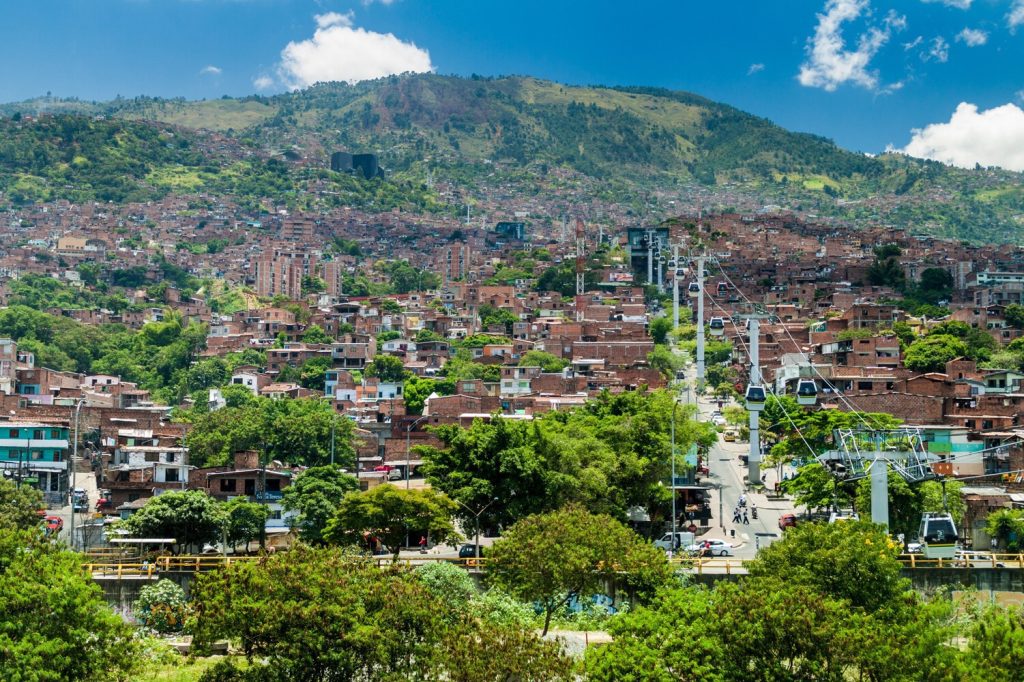 General view of a section of Metrocable descending a hill in Medellín.
But the great transformation in the urban mobility of Medellín began before the implementation of Metrocable, already in the 1970s the first steps were taken for the creation of a metro network. But it would not be until the end of 1995 when it could be inaugurated, after a long process marked by financial problems to carry out the project. Today, Metro de Medellín is known for being efficient, modern and environmentally friendly. By 2020, coinciding with its 25th anniversary, more than 4 billion users had used the Metro. In its first year of operation, 4 million trips were made, while in 2019, ridership reached 318 million. The two operational lines as of today have a total of 27 stations, more than 34 kilometers of track and 80 trains in operation. Currently under construction is what will be the third line, known as Line E or Metro del 80, which will start from Caribe station on Line A and run to Aguacatala. It will be a surface light train, is scheduled to open in 2028 and is part of the Medellín Metro Expansion Master Plan 2026-2030. This advance is the most important mobility milestone after Metro Lines A and B, a project that will benefit about 976,000 people in western Medellín, making a journey through fourteen stations and thus being able to integrate the Metro system with the remaining mobility network of the city. The Colombian government itself has stated that, as a fundamental point in its efforts to transform infrastructure and revitalize cities, the light metro prioritizes a highly functional, sustainable and cost-effective design.
 Current map of the different public transport networks in Medellín.
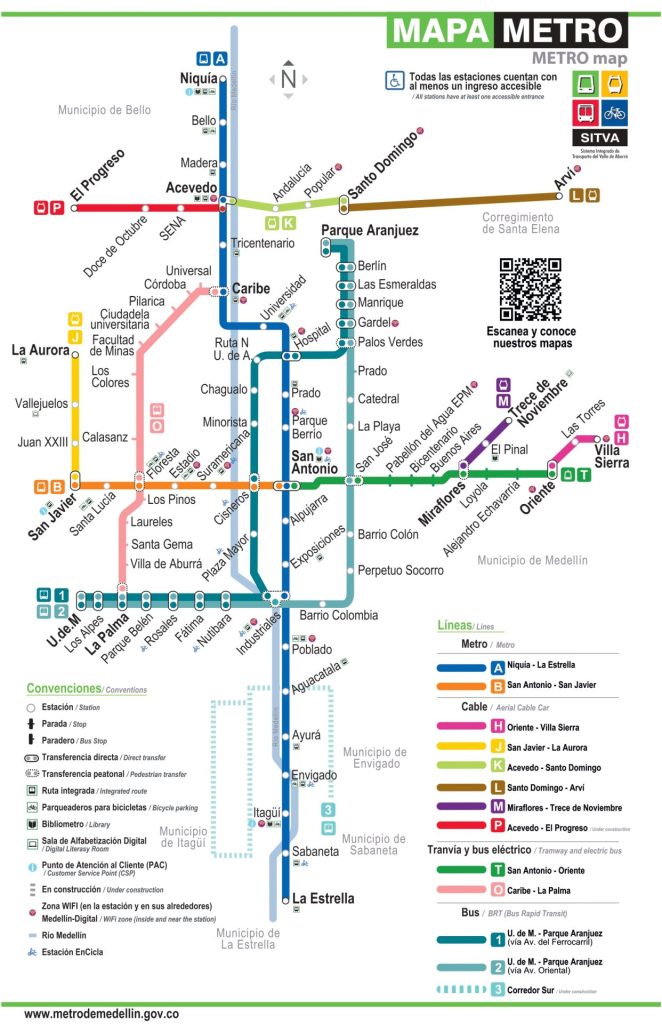 Current map of the different public transport networks in Medellín.
In addition to the Metro, Medellin residents have a tramway, bus line, bike lanes and Metrocable, probably the most iconic transport with the greatest economic, ecological and social impact. Another element that favors environmental care and the reduction of the carbon footprint are the intermodal trips by bicycle, which are slowly gaining prominence. In 2024, the number of bicycle lane users rose to 17,361. This figure represents an increase of 69 % compared to 2023 where 10,278 people were registered. Despite the efforts of local groups, Medellín has never been too friendly to cyclists. The orography itself does not make it easy: located in the Aburra Valley, in the central Andes mountain range, Medellín is surrounded by mountains and a good part of its neighborhoods are located on high hills. Bicycle use is low, at around 1% of trips, and the kings of mobility are still the motorcycle and the car (with one million and 600,000 vehicles respectively). Likewise, the city has stipulated the creation of a low-emission zone, one of the main barriers to its implementation is the distribution of goods through highly polluting vehicles, therefore, the project will focus on the implementation of logistics hubs and a last-mile goods distribution strategy through tricycles and bicycles. The aim is to reduce emissions that affect people’s health and cause climate change. As a result, it will enable the redistribution of public space, favoring more sustainable means of transportation and generating a friendlier and more sustainable city.
 Metrocable cabins crossing a wooded area on the outskirts of Medellín
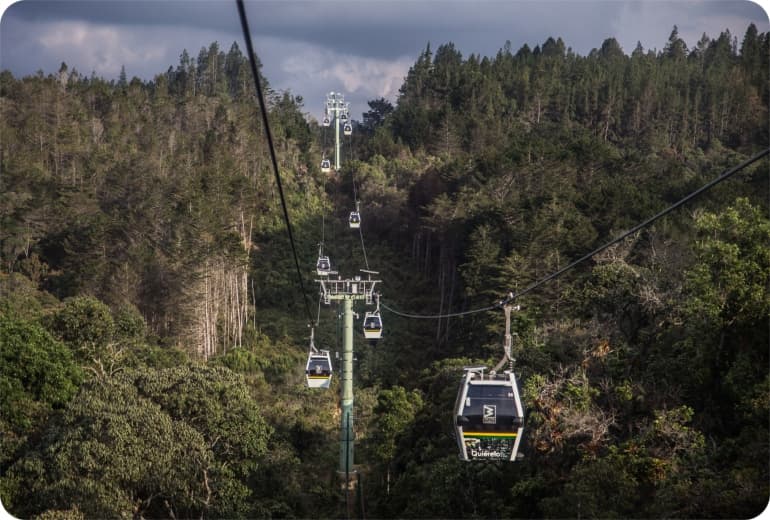 Metrocable cabins crossing a wooded area on the outskirts of Medellín
Under a planning and design approach to cities that prioritizes environmental sustainability, the efficient use of natural resources, the creation of green spaces and social wellbeing, the concept of “15-minute cities” has emerged. This refers to developments where residents can access all educational, employment, commercial, recreational, transportation and health services within a 15-minute walk or bicycle ride from their homes. This seeks to reduce travel time, improve the quality of life and reduce the ecological footprint. Medellín is promoting this type of global approach in urban planning projects, where more than 120 hectares of green spaces have already been created in urban areas. Another way in which they are committed to sustainability is with the creation of wild urban spaces. Another way they are committed to sustainability is by creating wild urban spaces. Recycling bridges reduces 40% of natural resource extraction, 70% of electricity consumption and 20% of potable water use, in addition to reducing 65% of solid waste generated and 50% of CO2 and greenhouse gas emissions. Because Medellín is a clear example of how sustainable urban planning can generate social, economic and environmental benefits. Investing in public transportation innovation, in the recovery of urban infrastructure, sustainability and citizen connection, improves people’s lives and generates economic opportunities for businesses.
At Vectio | Traffic & transport planning we have carried out mobility and transportation projects in Colombia and throughout Latin America.
Links:
https://www.cntraveler.com/gallery/cities-with-best-public-transportation