

The boost to maritime trade
The immense wealth of its subsoil, which makes it one of the world’s leading producers of zinc, tin, silver and lead, but above all copper and phosphates, makes Peru an object of desire for the world’s major economies, which are in high demand for these raw materials. The country thus lives up to the expression coined in colonial times, which was used to refer to something of incalculable value as being ‘worth a Peru’. But it is not only mineral resources that are part of the attractions that have made Peru a point of special interest for foreign investment, particularly from the People’s Republic of China. Chinese companies are behind the two most important projects in Peru in recent decades, which aim to transform the transport of goods and people in the country. The Chancay megaport, which is in the start-up phase, and the planned Lima-Ica railway, which will reach speeds of 200 km/h, are the first two major public works projects in a country that, like China in the 1960s, is aiming to take a giant leap forward.
Located north of Lima and inaugurated in 2024, with an investment of close to £3.5 billion, the deep-water port of Chancay has revolutionised trade between South America and the Asian giant. Shortening the journey between China and one of its preferred markets by up to 15 days, the port is mainly operated (60%) by COSCO Shipping Ports, while the mining company Volcan holds 40%. In the initial phase, it is estimated that the new Chancay container terminal will be able to handle up to one million TEUs per year and create thousands of direct and indirect jobs in the area. Despite geopolitical pressures against Chinese presence, environmental controversies and local population concerns, Chancay promises to mark a turning point in global trade and create thousands of jobs, in the shadow of the Belt and Road Initiative (popularly known as the 21st Century Silk Road). This ambitious project, led by Xi Jinping himself and signed by 21 Latin American countries, has led to substantial investment in public works, led by companies in which the Chinese state has a stake as a necessary condition. Behind this agreement are such transformative projects as the Bogotá metro, the port of Santos in Brazil and the Manta airport in Ecuador. Similarly, the debt that many South American countries have incurred with China continues to grow, with China now being the second largest creditor in the region, which is fuelling talk of an unequal and domineering relationship.
But it is not only Chinese investment in the Chancay megaport project that is transforming trade, mainly in mineral exports, between Peru and the rest of the world. Up to a dozen new maritime terminals were under construction or in the planning stages at the beginning of 2025, in a country whose role in world trade has never been so significant. In fact, construction and engineering companies from 11 different countries are working on the various projects, with US and Chinese companies playing the leading role. It is estimated that by 2030, maritime container transport will double, from 28.9 million tonnes in 2023 to more than 60 million in 2030. In addition, the transit of solid and liquid bulk, other types of goods and rolling cargo will also increase substantially. Similarly, the intended boost to cabotage, the internal transport of goods and people between different Peruvian ports, will represent another significant advance in this same line.
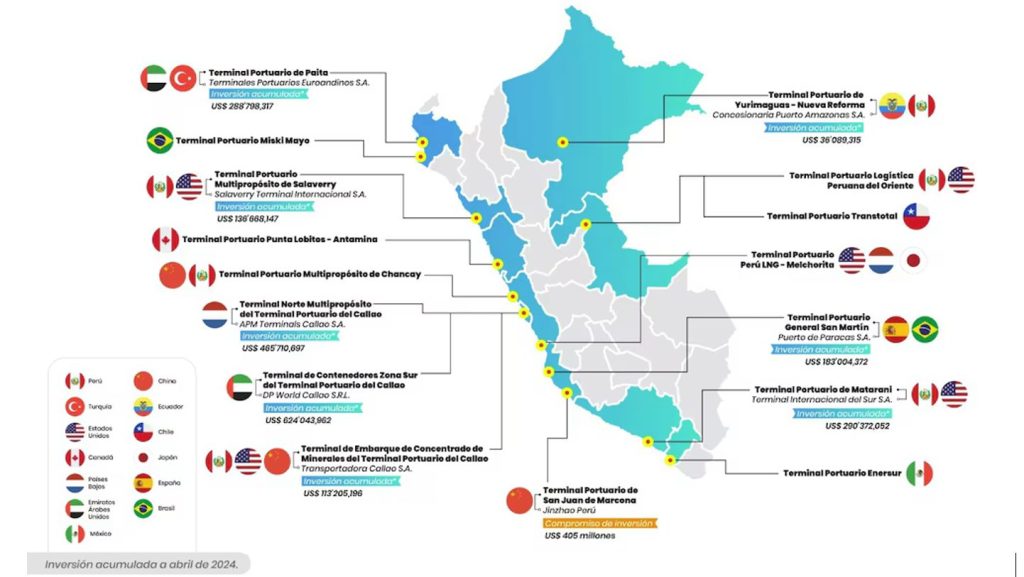 Map of international investments in Peruvian government concessions. Source: Bloomberg.
New road and rail infrastructure
In addition to the significant boost to maritime traffic, over the next five years the Peruvian government will undertake a major infrastructure investment plan, with several projects led by foreign capital. These are some of the main projects currently under development:
· Peripheral Ring Road (Lima-Callao)
A 34.8 km urban motorway that will connect Óvalo 200 Millas (Callao) with Av. Circunvalación (San Luis), crossing 11 districts. It includes a Bus Rapid Transit (BRT) corridor and connections to other systems such as the Metro, Metropolitano and the future cable car. Awarded for more than €3 billion, part of a 30-year concession, with estimates of generating 5,000 direct jobs and more than 70,000 indirect jobs.
· Metro Lines (Lima-Callao)
Currently under construction, its first 5-kilometre stage has already connected Evitamiento with Mercado Santa Anita since December 2023. The entire line (27 km) is expected to be completed by 2028. It is considered a strategic project to increase the efficiency of mass transport in the capital.
· Modernisation of the Huancayo–Huancavelica railway line
Comprehensive renovation of 128.7 km of track, acquisition of rolling stock, maintenance works and operation for 30 years. The total budget amounts to US$565 million, which includes US$445 million for modernisation and US$120 million for the first 10 years of operation. The Huancayo-Huancavelica railway modernisation project is not simply an infrastructure improvement; it is a significant investment in Peru’s future.
· Lima–Ica railway line
Work on the Chinese-financed high-speed train between Lima and Ica, with a total length of 323 km, is scheduled to begin in the first half of 2026. It will include viaducts, tunnels and 15 stations, with estimated speeds of up to 200 km/h for passengers and 100 km/h for freight transport. The estimated cost of the megaproject is $6.5 billion, according to the Ministry of Transport and Communications, running parallel to the Pan-American Highway. It is projected to carry 45,000 passengers daily, reduce traffic and pollution, and promote regional tourism and trade. The official estimate is that it will have the capacity to transport 57 million passengers per year.
· Potential railways and mega-corridors
This category includes two projects that are still under study and which, if implemented, would serve to connect different transport infrastructures. The first is the line that would connect the mega-port of Chancay with the town of Pucallpa, near the Brazilian border. Similarly, the Coastal Railway Corridor connecting Barranca and Trujillo is in the study and pre-investment phase. It would be financed by CAF through MCDF for this critical section of the larger Tacna–Tumbes project (2,500 km) and would have the potential to move 30 million passengers and 60 million tonnes of cargo per year by 2030.
· Sierra Longitudinal Corridor – Section 4
This is a US$1.582 billion concession to rehabilitate, construct and maintain approximately 965 km of roads between Huancayo, Ayacucho, Andahuaylas, Apurímac and Pisco. It includes a bypass around San Clemente (5.2 km), improvements to sections of road and initial maintenance for 25 years.
· Cable car to Choquequirao
The purpose of this project is to facilitate tourist access to the archaeological site of Choquequirao from Cusco and Apurímac using a mixed system (cable car and buses). The cable car network is intended to improve access to Machu Picchu’s ‘little sister’, which the government believes has great potential as a tourist attraction. This is one of the projects included in the investment plan for the period 2025–2026, during which it is estimated that 80 new projects will be awarded through public-private partnerships, for a total amount of more than 17 billion dollars. The authorities point out that the Choquequirao Cable Car will transform the tourist experience in Cusco and Apurímac with 10.6 kilometres of transport, as well as promising to increase the flow of tourists from 800,000 to more than one million visits per year. It is estimated that the impact of this transport system will be as transformative for the environment as the reduction in travel time to the Choquequirao site: from two days to just over 20 minutes.
 Railway convoy passing through a town in the interior of Peru.
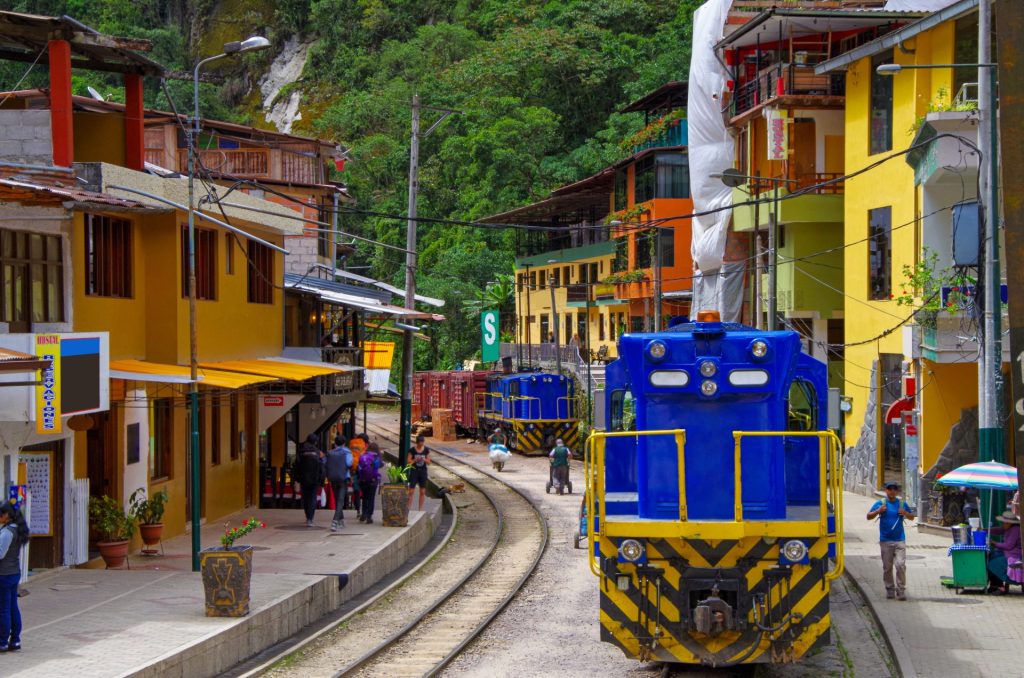 Railway convoy passing through a town in the interior of Peru.
· Mega railway project: the Peru-Brazil Bi-Oceanic Railway
All the figures for this project are monumental. It is one of those infrastructure projects that, if completed, could change the balance of international trade and even global geopolitics. The initial idea is to connect two ports that are currently 5,400 kilometres apart by road: Bayóvar in the Peruvian province of Piura and Santos, the most important port in Brazil. The new railway line, which would be over 4,000 kilometres long, would first of all reduce the current journey time by several hours, but above all it would exponentially increase the amount of goods transported at a very competitive cost. There is talk of a capacity of up to 40,000 tonnes per day, a third of the daily traffic of the port of Rotterdam (the largest in Europe) and a quarter of that of Shanghai (the largest in the world). The estimated cost of this transnational megaproject would exceed £12 billion, although today it is a pipe dream to think of crossing the Andes, the Amazon rainforest, indigenous and protected territories, as well as areas that are very difficult to access and have complicated terrain. The estimated cost of this transnational megaproject would exceed $12 billion, although today it is a pipe dream to think of crossing the Andes, the Amazon rainforest, indigenous and protected territories, as well as areas that are very difficult to access and have complicated terrain. The first of the six sections to be built in Peru (the one that would run between Bayóvar and Olmos) alone would require 44 kilometres of tunnels, which serves as an example of the extreme complexity of the project. Although the timeframe for the project is still very vague and depends on economic, technical and political factors, if it goes ahead it would be a transformative project that could create around 200,000 jobs.
· Airport infrastructure: Chinchero International Airport (Cusco)
New international airport in Chinchero (Cusco), at an altitude of 3,720 metres, scheduled to replace the current one. Estimated opening between 2026 and 2027, with an approximate investment of around 550 million dollars. This is a landmark project that will improve the country’s air connectivity, as it will have the capacity to receive more than 8 million passengers per year, enabling sustainable growth in domestic and international tourism and improving local and regional socio-economic development.
Advances in sustainable mobility and improvements
In the field of sustainable mobility, Peru has also been making progress in recent years with measures aimed at accelerating the still tentative shift towards electrification of the vehicle fleet and the consequent abandonment of fossil fuels. It is doing so, moreover, in a context marked by technical, economic and structural barriers. The national strategy includes studies, agreements, public and private pilot projects, clear targets (2030–2040), tax incentives, intermediate fuels and partnerships, all geared towards a coherent energy transformation adapted to the local context. The key will be to consolidate clear public policies, expand infrastructure (especially charging infrastructure), ensure diversified financing, involve the private sector and citizens, and operate from a logic of just transition, where sustainability does not sacrifice accessibility or equity. With a strategic and integrated approach, Peru has the opportunity not only to reduce emissions, but also to modernise its transport system, improve quality of life and meet its climate commitments.
On the other hand, in recent years, Chinese state-owned companies have acquired strategic assets in Lima’s electricity sector. Specifically, the energy giants Three Gorges and Southern Power Grid were the ones who took the step of entering the capital’s market in 2020 and 2023, respectively. This has caused some alarm due to possible monopolistic concentrations and geopolitical risks, which once again highlight the important commercial and strategic relationship that Peru has been gaining for the Asian giant over the last decade. The United States is particularly sensitive to this Chinese presence and is concerned about its ability to operate strategic infrastructure (such as the port of Chancay), which has potential for dual use (commercial and military). Risks of dependence and impact on sovereignty have been pointed out, especially in critical sectors such as ports and energy. In contrast, Peruvian analysts and authorities highlight the immediate benefits: connectivity, infrastructure modernisation, job creation and economic growth.
 View of Lima with the Pacific Ocean coastline.
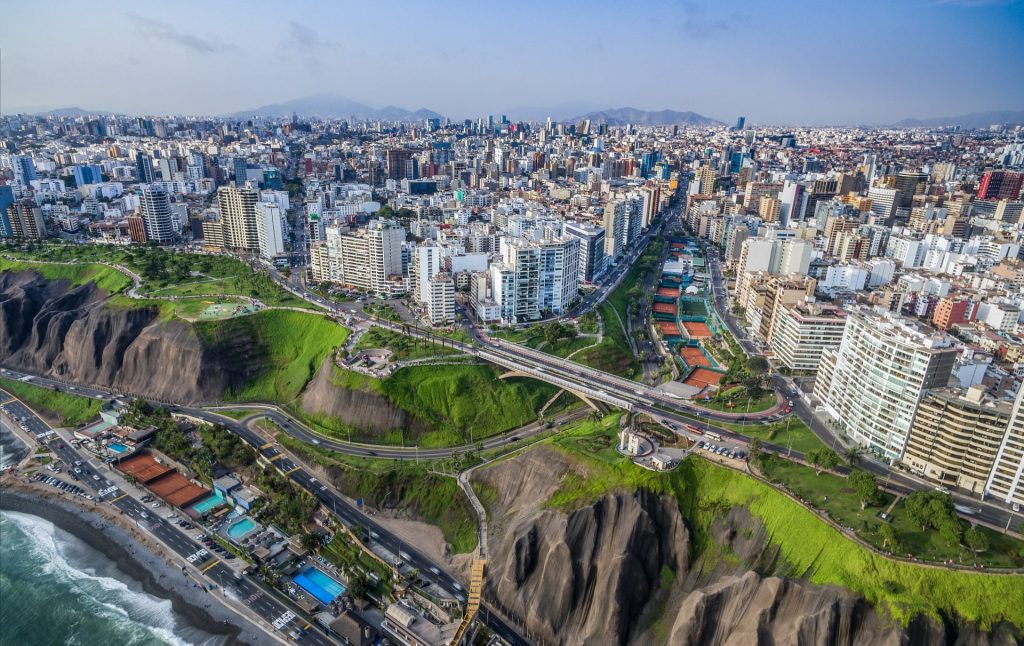 View of Lima with the Pacific Ocean coastline.