

The changes that big cities have gone through in the first quarter of the 21st century have led to new ways of getting around and new logistics, especially last-mile delivery. The incorporation of more environmentally friendly means of transport, the commitment to pedestrian areas and restrictions on traffic in city centres have also been a determining factor in this paradigm shift, which seeks to reduce pollution and improve people’s lives. In the coming months, Madrid will inaugurate its new urban mobility centre in the basement of the iconic Plaza de España, which promises to be a national benchmark for this type of hub that seeks to combine various sustainable mobility strategies. Other European cities have been moving in this direction for years, developing pioneering systems that, in many cases, are proving to be a success due to their popular acceptance and the level of achievement of their objectives. Let’s review some of these examples that have paved the way for many cities around the world to follow today.
Bremen and its car-sharing programme
Bremen is one of Europe’s pioneering cities in sustainable mobility, thanks to its promotion of public transport, cycle lanes and pedestrian zones. The northern German city is also a benchmark in the field of urban mobility hubs, having launched its Mobil. Punkt, a pioneering large-scale public car-sharing programme, which, two decades later, has proven to be a success. Originally, 10 main stations were installed for parking shared vehicles, then another 14 smaller stations were added, and now there are up to 150 stations of different sizes throughout the city. According to the latest data published by https://mobilpunkt-bremen.de , up to 28,000 residents of Bremen are already users of a system that allows them to enjoy a vehicle on demand without having to face the purchase and maintenance costs of owning one. A total of 530 vehicles have a fixed parking space, while another 120 can be rotated between the different stations. Each car-sharing vehicle in Bremen is used by an average of more than 45 users, and since car-sharing users can often do without their private vehicles, each vehicle replaces 16 private cars. Bremen is also home to the Hollerland neighbourhood, where experiments are underway to reduce private vehicles as much as possible. The idea arose from a study of the space requirements for parked and moving cars. Almost a quarter of the total area can be used for other purposes as parking space is no longer necessary. Using a car-sharing system for residents, only 17% of road space is needed for parking, compared to 40% for a system based on private vehicles.
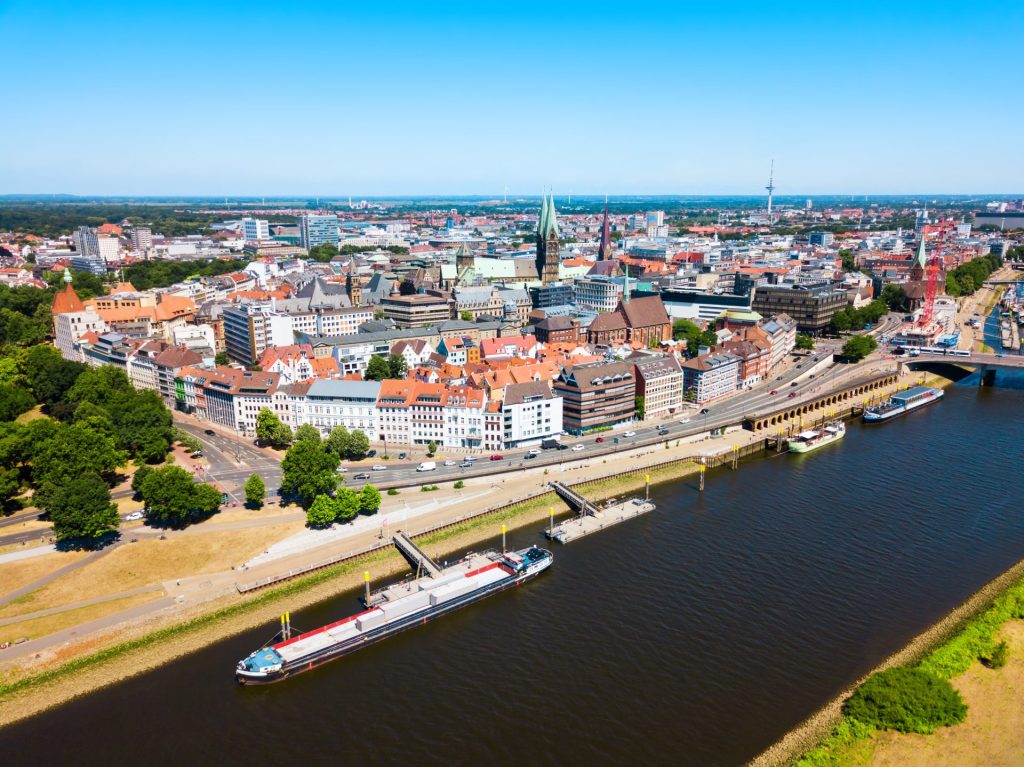 Panoramic view of Bremen with the River Weser
Copenhagen and its commitment to cycling
The capital of Denmark is famous for its strong commitment to cycling as a means of transport, which is already used for 30% of commutes in summer, compared to 37% for public transport and 30% for private cars. The goal set by local authorities five years ago was for 75% of all journeys to be made by public transport, bicycle or on foot. In line with this, it wanted to be the first carbon-neutral city in the world by 2025, and cycling was a key part of achieving this goal. This policy has been based on several fundamental points: the construction of an extensive network of segregated cycle lanes, public bicycle systems, subsidies for the purchase of bicycles, and a major public awareness and incentive campaign. A study recently published in the journal Proceedings of the National Academy of Sciences (PNAS) stated that if every city increased its cycling network to the level of Copenhagen, greenhouse gas emissions would be reduced by 6% and public health benefits would reach €381 billion per year. The study, which collected data from 11,500 cities in 121 countries, highlights the 546 kilometres of cycle lanes in a city where the number of bicycles is already five times higher than that of private cars. However, the success of the Copenhagen model is not exclusively due to bicycles, but is the result of a strategic vision that, taking ideas from 15-minute cities, the vision of architecture designed for people and the regeneration of degraded areas such as the port, has radically changed the city. In 1962, the Danish capital made a controversial decision: to pedestrianise one of its main thoroughfares. Within a year, pedestrian traffic increased by 35%, and by 2005, the space dedicated to pedestrians throughout the city had increased sevenfold. As defined by Danish urban planner and architect of part of this transformation, Jan Gehl: ‘life, spaces and buildings, in that order’.
 Two residents of Copenhagen cycling in the city centre
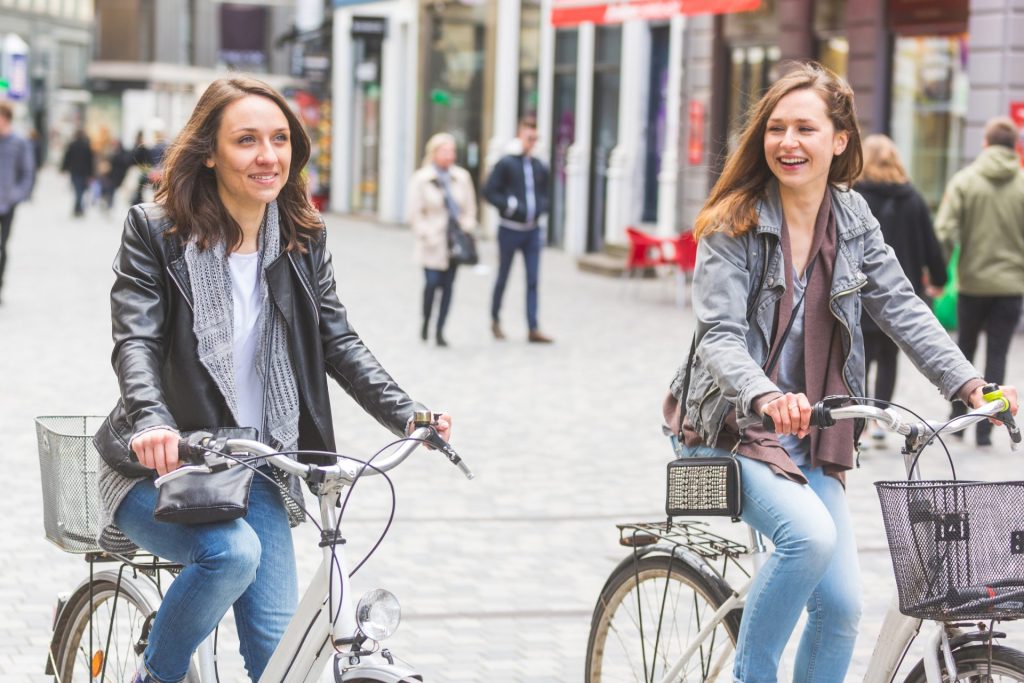 Two residents of Copenhagen cycling in the city centre
The Freiburg Energy Sustainability and Mobility Laboratory
In southern Germany, Freiburg, the capital of the state of Baden-Württemberg, has become a laboratory for sustainability in recent decades, both in terms of the environment and mobility. Known as ‘the capital of the sun’ due to its more than 15,000 m2 of installed solar panels, it aims to be energy sustainable by 2050. With 43% of its area covered by green spaces, Freiburg is a paradigm of coexistence between economic and ecological models, with good results in both fields. While the city continues to grow in terms of quality of life and wealth creation, carbon dioxide pollution has been reduced by more than 20% since 1990, and it aims to significantly increase this reduction over the next five years. A fundamental part of this strategy is the change in the urban mobility model, giving a leading role to public transport and bicycles. Private vehicles are so insignificant that there are areas such as the Vauban neighbourhood where 70% of residents have given up owning a car. In fact, much of the private vehicle traffic corresponds exclusively to goods delivery services and taxis. Modern trams are the backbone of urban mobility in the city, supported by an extensive network of cycle lanes interconnected with the most important hubs. This is why the Central Station is also known as ‘the bicycle stadium’ due to its parking facilities for 1,000 bicycles. Returning to Vauban, this modern neighbourhood is currently the global benchmark for energy and environmental sustainability, as its solar panels generate twice the energy the neighbourhood needs, its modern tram network and extensive cycle paths meet its mobility needs, and its park-and-ride facilities and car-sharing service mean that it is very rare to see a private car on its streets.
Historic centre of Freiburg, rebuilt after the Second World War
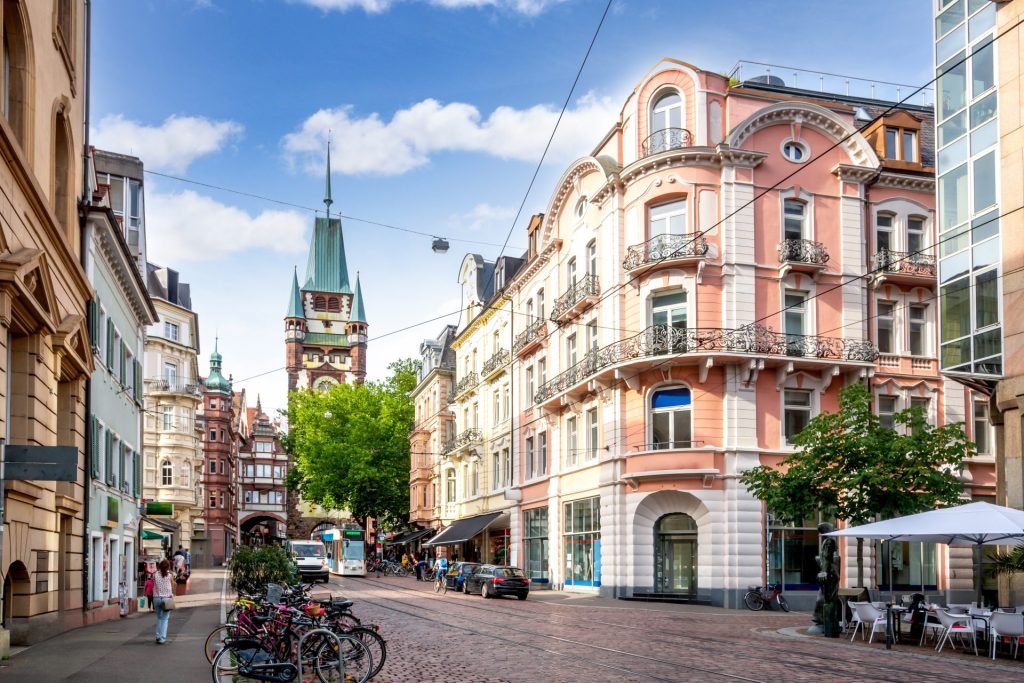 Historic centre of Freiburg, rebuilt after the Second World War
Based on the lessons learned from success stories such as these, as well as the growing mobility and logistics needs of a large city like Madrid (which is 15 times the size of Freiburg and 6 times the size of Copenhagen), solutions such as the new Plaza de España hub are emerging. In an environment of traffic restrictions to reduce emissions, an extensive metro and urban bus network, and a stone’s throw from popular attractions such as the Royal Palace and Gran Vía, it offers many possibilities to become a national benchmark. Managed by the Madrid Municipal Transport Company, it will have 23 electric charging points, a car-sharing and car rental service, Bicimad, BiciPARK, parcel lockers and spaces for urban goods distribution, as well as 690 parking spaces. In a world that is constantly evolving towards healthier and more sustainable modes of mobility, recovering and adapting environments in the centre of our cities to the new mobility no longer seems like an option, but an obligation.
At Vectio, we have been working for two decades to improve mobility in urban environments, working for public administrations such as Madrid City Council and world leaders in logistics distribution such as Amazon.
Links:
https://www.vcd.org/themen/multimodalitaet/beispiele/mobilpunkt-bremen
https://viajes.nationalgeographic.com.es/a/barrio-vauban-ciudad-futuro-esta-friburgo_17680