

Cities such as Copenhagen (1960) and Arnhem (1974) led the way with their first segregated bike lanes, but in Spain it was not until the 1990s (and especially from 2000) that they began to be integrated into Sustainable Urban Mobility Plans (PMUS). The increase in vehicular flow on the roads, traffic congestion and pollution, prompted the need to rethink urban mobility. Thus, bike lanes emerged not only as a solution to improve the safety of cyclists, but also as a bet towards the creation of a cleaner, healthier and more efficient city model, promoting an environmentally friendly means of transport and active mobility.
Currently, this structure has become a key element for many cities around the world, promoting new values and lifestyles. Such as the Bogotana Ciclovía, which has established itself as a symbol of social integration, public health and urban sustainability. By suspending vehicular traffic from the streets on Sundays and holidays, every week more than a million people enjoy a car-free city by riding more than 127 km of roads enabled for cyclists, pedestrians and recreational activities.
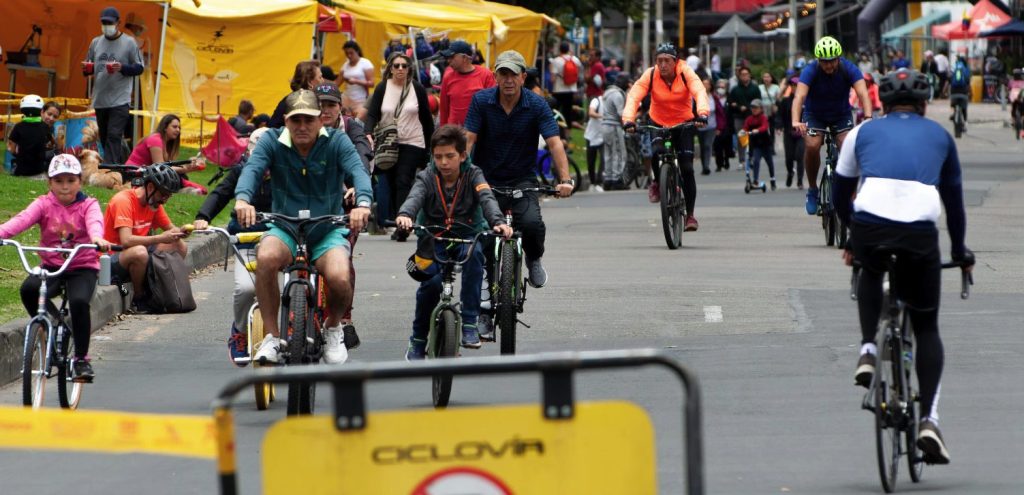 Users enjoying Ciclovía Bogotana. Photo: Mayor’s Office of Bogota.
Signage and technology
Signage on bikeways was initially fairly simple, with pavement markings and some basic signage, but technology, lane expansion, safety, and growing concern for sustainability and energy savings have led to modernized signage. In some cities, signs are being incorporated with LED lighting, sensors and intelligent systems that adapt signage in real time according to traffic conditions, time of day and the effects of climate change.
The dual function of bike lanes: means of transport and energy supply
In 2014, the Netherlands gave a hint of what the bike lane trend of the future would be: long paths linking cities and surfaces that generate solar energy. The Dutch pilot project, SolaRoad, incorporated electricity supply technology for street lighting and even domestic use into the bike paths. This pavement had photovoltaic cells integrated into concrete modules whose upper part is covered with a double layer of tempered glass. The solar section of the bike path consisted of 2.5 x 3.5 m concrete modules, which were assembled one after the other. The cells were placed under a 1 cm thick layer of tempered glass. The solar section of the bike path consisted of 2.5 x 3.5 m concrete modules that were assembled one after the other. The cells were placed under a 1 cm thick layer of tempered glass. The system ended up failing in 2020 due to the concatenation of several critical factors: the defective generation of electrical energy from the pavement, the great wear and tear suffered by the panels and the excessive noise generated by the passage of bicycles.
 Photovoltaic bike lane in the median of the highway between Daejeon and Sejong, South Korea. Photo: South Korean Ministry of Infrastructure and Transportation.
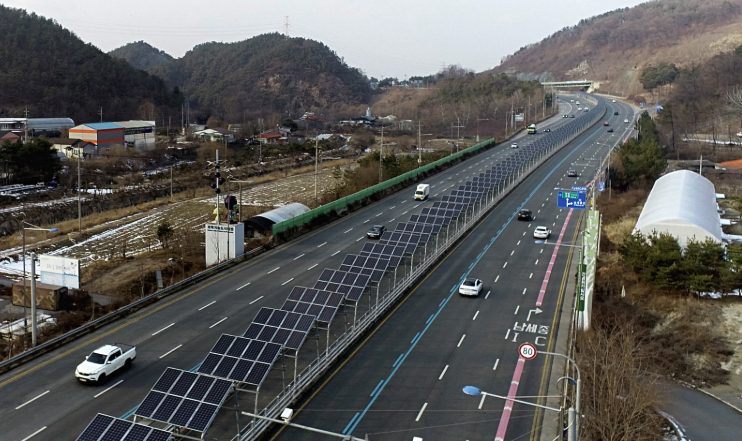 Photovoltaic bike lane in the median of the highway between Daejeon and Sejong, South Korea. Photo: South Korean Ministry of Infrastructure and Transportation.
As a variant to this type of bike lane where the solar panels are placed on the pavement, we have the example of South Korea. In 2014 it developed an innovative 9km bike lane equipped with a roof of solar panels extending over 4.8km, located in the median of the highway connecting the cities of Daejeon and Sejong. It generates an average of 2,200Mwh of energy per year, enough to power 600 homes, street lighting and electronic panels in the city of Sejong. In addition, this type of infrastructure provides cyclists with a means of shade and indirectly contributes to thermal regulation on hotter days, which significantly increases the comfort of cycling.
In Germany, in 2023, a 300-meter bike path covered by 900 photovoltaic and translucent modules, capable of generating 280MWh, was inaugurated in the vicinity of the Euro-Park Stadion, the home of Freiburg, which plays in the German Bundesliga.
And finally we find Solar Veloroute, an example of design, architecture and sustainability. Architect Peter Kuczia has reinterpreted the typical bike path through a sustainable approach by creating a photovoltaic road for cyclists and pedestrians, where they can enjoy illuminated paths, charging stations for bikes and smartphones, and shelter from the sun. According to Kuczia, a single kilometer of the Solar Veloroute structure could provide about 2,000 MWh of electricity to power 750 families or supply electricity to more than 1,000 electric cars traveling 11,000 kilometers a year.
 Infographic of the Solaroute photovoltaic bike lane proposed by Peter Kuczia.
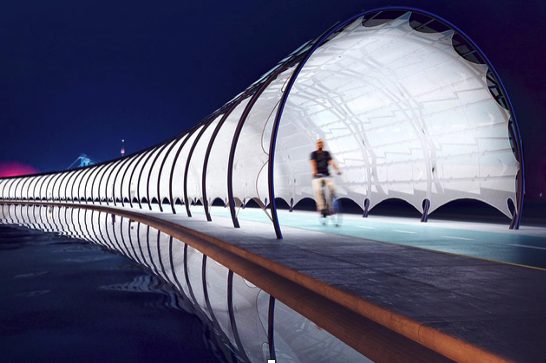 Infographic of the Solaroute photovoltaic bike lane proposed by Peter Kuczia.
In Spain, there is the scalable pilot project initiated in 2013 called SmartUIB, located on the campus of the University of the Balearic Islands. In the first phase, a section of solar-only bike lane will be installed, which will be extended in a second phase by installing kinetic technology, giving rise to a hybrid bike lane. Due to its design and technology, it also allows the integration in the same lane of fixed LED and dynamic signaling systems for the width of the lane. The infrastructure produces part of the electrical energy for the consumption of the Ca ses Llúcies Innovation Center building.
Floating bicycle highways and VMPs: The solution for micro-mobility
In order to gain space and lanes on the road, and to address the fact that many streets do not have enough physical space to install bicycle lanes, a floating bicycle highway has been created in the city of Basel, Switzerland. This 200-meter-long pilot project consists of 20-meter modular rails. These are easy to assemble and their design makes it possible to incorporate more functionalities such as heating elements to prevent the accumulation of snow and ice, lighting or solar panels to produce renewable energy. The cost of a route and support is around 2.5 million euros per kilometer (ramps for ascent and descent represent additional costs).
 Example of bike lane installation on an alternative road to the asphalt lane. Photo: www.urb-x.ch
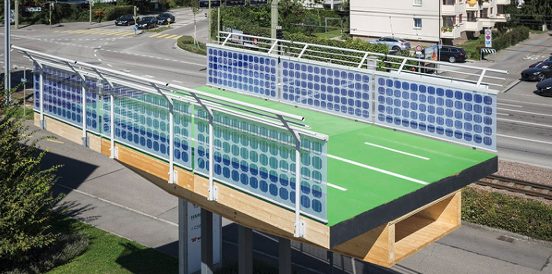 Example of bike lane installation on an alternative road to the asphalt lane. Photo: www.urb-x.ch
The supply of segregated cycling infrastructure and the use of bicycles have increased in recent years, reflecting a transformation in urban mobility aligned with the design of Sustainable Urban Mobility Plans (SUMPs). One example is the design of the Madrid 360 Sustainable Mobility Plan, which projected a 9.1% increase in bicycle lanes by 2025, representing 35 km of new lanes. Within this context, and the technological advances exposed around cycle paths, new opportunities are opening up towards the transformation of more sustainable, intelligent and livable cities.
From Vectio, as a consulting firm specializing in mobility and urban planning, we position ourselves as a strategic ally in the implementation of SUMPs that respond to current demands.
Do you want to know more? Visit https://vectio.com/contact/
Links:
https://www.idrd.gov.co/ciclovia/historia
https://ciclosfera.com/a/abierto-y-funcionando-el-primer-carril-bici-solar-de-alemania
https://ecoinventos.com/solar-veloroute/
https://somoselectricos.com/carretera-flotante-solar-bicicletas-solucion-problemas-espacio/
https://diari.uib.es/Hemeroteca/El-primer-carril-bici-solar-de-Espana-se-instalara.cid413119