

For decades, talking about railways in the Canary Islands has been almost an exercise in political nostalgia: plans, models, technical documents and newspaper headlines that never actually materialised into construction projects. However, something has changed over the last two years. For the first time, the island railways in Gran Canaria and Tenerife have ceased to be merely an aspiration and have entered a phase which, without any triumphalism, can be described as realistic.
What has happened to mean that what was not achieved in the last 50 years is now beginning to move forward?
A long history: projects born before their time
The Canary Islands are no strangers to railways. Gran Canaria even had an urban tram system in the late 19th century and a rudimentary railway system during the post-war years of energy shortages. But the modern debate over a high-capacity intercity train really emerged in the 1970s, when a structural problem began to become apparent:
- sprawling urban growth
- heavy reliance on private cars
- progressive saturation of the island’s main motorways.
Since then, the idea of a train never disappeared… but nor did it progress far enough to become a reality.
Why it was never achieved (until now)
Although each attempt had its own particularities, the obstacles have been surprisingly consistent:
a) Cost and funding
Island railways are multi-billion-euro infrastructure projects, impossible to fund through ordinary annual budgets. For years, there was no stable funding framework, equivalent to the Roads Agreement. Every political change meant starting from scratch.
b) Environmental assessment
In small, densely populated and environmentally sensitive areas, the environmental assessment is lengthy and complex. In Gran Canaria, the process began in 2010, stalled for years and was not restarted until 2023. In Tenerife, some studies even lapsed, forcing the process to be restarted.
c) Lack of clear governance
For a long time, it was not clearly defined who was in charge, who was funding the project and who would operate the system. Island councils, the regional government and the central government were moving at different speeds, without a robust framework for shared responsibilities.
d) Social and territorial debate
There has been no shortage of criticism: environmental impact, the rigidity of the system, doubts about demand, or comparisons with more flexible solutions (rapid buses, bus lanes). That debate has influenced — for better or worse — the pace of political developments.
So… what has changed now?
Three factors explain this shift:
1) A financial framework under development
Since 2024, the Canary Islands have been formally negotiating with the Spanish government a multi-year agreement for railways, similar to that for roads, recognised as the only realistic way to ensure financial continuity beyond a single political term.
2) Institutional protocols signed
In 2025, both Gran Canaria and Tenerife signed tripartite protocols (Spanish Government–Canary Islands Government–Island Councils) which:
- allocate responsibilities,
- establish monitoring committees,
- set out the technical, economic and administrative steps.
For the first time, the railway ceases to depend solely on political will and enters into a structured project framework.
3) Key administrative milestones
The most significant breakthrough has occurred in Gran Canaria, where in April 2026 a favourable Environmental Impact Statement was obtained, following 16 years of processing. This marks an administrative point of no return.
Current projects: what’s really on the table
🚆 Gran Canaria Railway (Las Palmas – Airport – South)
- Length: ~58 km
- Stations: 11
- Journey time: ~35 minutes
- Maximum speed: up to 160 km/h
- Current status:
- Funding and governance agreement signed.
- Favourable Environmental Impact Statement (April 2026).
- Implementation planned in phases, starting with the Airport–Vecindario section, which has the highest potential demand.
The project connects the capital, the airport and the southern tourist areas – the island’s main economic hub – and aims to offer a genuine alternative to the GC-1.
🚆 Tenerife: Southern Line and Northern Line
Southern Line
- Santa Cruz – Adeje corridor
- Prioritised first phase: San Isidro – Costa Adeje (estimated at ~€950 million).
- New environmental study underway (the previous one has expired).
- Institutional protocol signed in 2025.
Northern Railway
- Currently in the feasibility study and ideas competition phase.
- Technically more complex due to the terrain and urban density.
Tenerife is making progress, but is one step behind Gran Canaria due to the need to redo part of the environmental assessment.
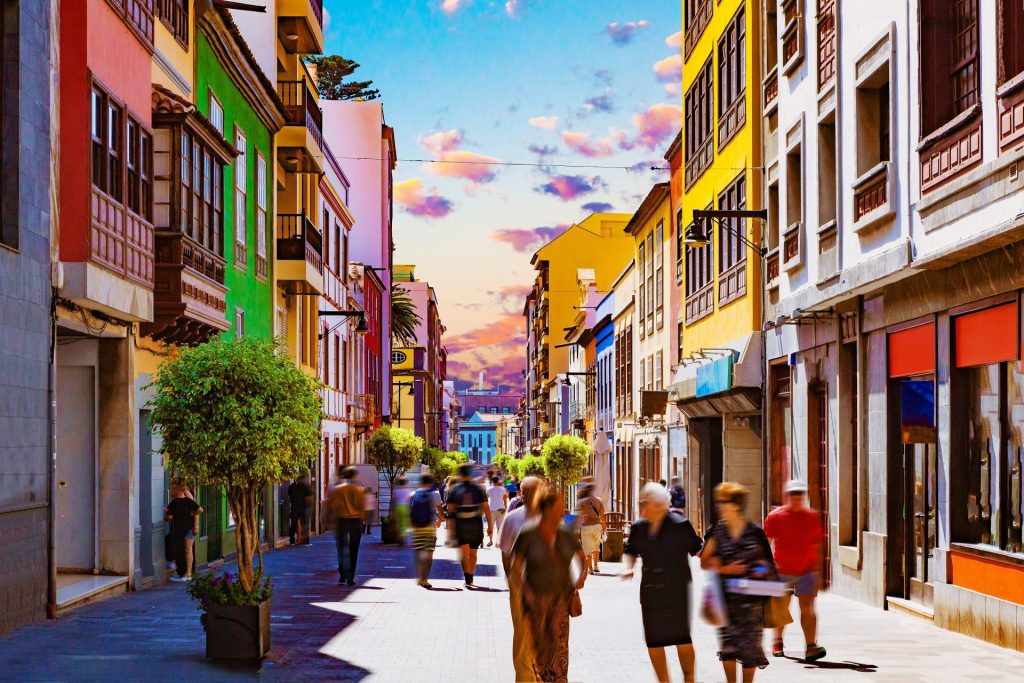 The resort town of La Laguna, one of the places that could benefit from the arrival of the railway in the Canary Islands.
What impact could this actually have?
🚦 Mobility
The train does not aim to “replace the car”, but rather to make public transport competitive on routes where road capacity has reached its limit: greater capacity, more reliable journey times and less vulnerability to accidents or traffic peaks.
🌱 Environment
The environmental impact depends on how many journeys are shifted from car to train. Operating with electric traction and, in the case of Gran Canaria, with renewable self-consumption, allows for significant reductions in operational emissions, provided that demand responds.
💼 Economy
Less congestion means:
- time savings,
- greater productivity,
- better access to work,
- direct employment in construction and operation,
- and greater regional competitiveness.
Specific socio-economic assessments already exist that support this logic, particularly in Gran Canaria.
🧳 Tourism
For destinations with high visitor numbers, mobility is part of the experience. Connecting the airport, the capital and tourist areas quickly and reliably has a direct impact on the quality of the destination and its medium-term sustainability.
 A winding road through the mountains of Tenerife.
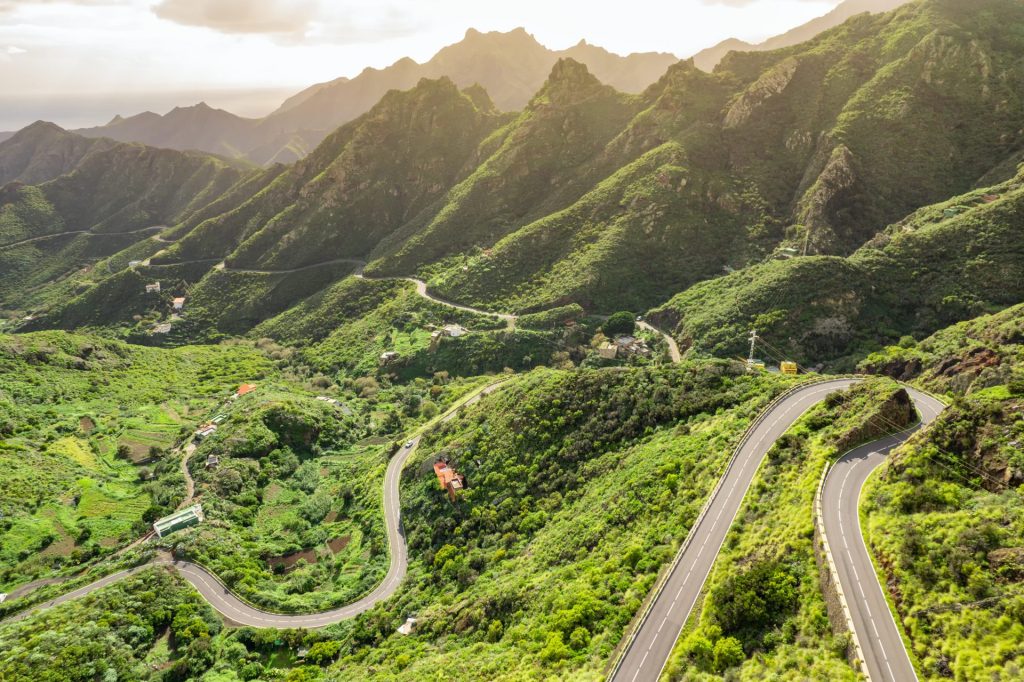 A winding road through the mountains of Tenerife.
Conclusion: this time it’s for real… but with conditions
Never before have so many factors come together:
✔ mature projects,
✔ clear governance,
✔ decisive environmental progress,
✔ and a serious attempt to secure funding.
Even so, the railway in the Canary Islands is not a foregone conclusion. Its success will depend on finalising the financial framework, implementing it in coherent phases, and accompanying it with genuine policies on intermodality and car management.
If that happens, the railway will—at last—move from being a recurring project to becoming transformative infrastructure.
 A view of Adeje, another of the destinations served by the planned railway lines in the Canary Islands.
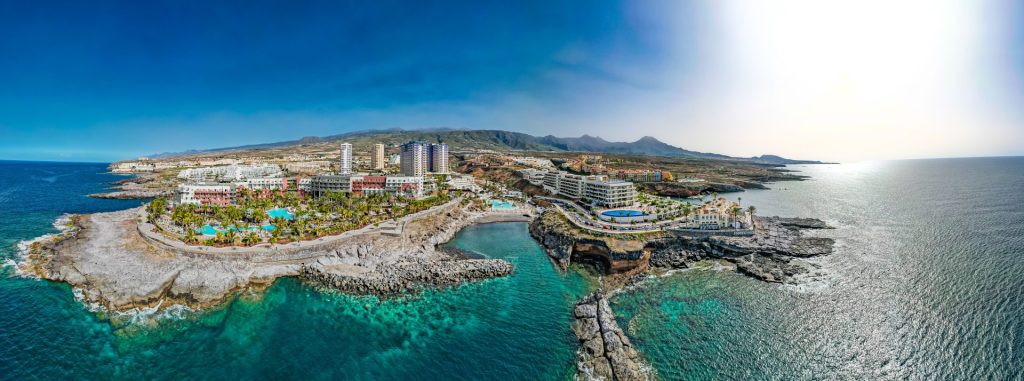 A view of Adeje, another of the destinations served by the planned railway lines in the Canary Islands.
At Vectio, we have been working on projects in the Canary Islands for many years and have extensive experience in mobility and transport developments for new infrastructure.
About Vectio
At Vectio we focus on the effective planning of sustainable mobility; we are experts in this field. Throughout our nineteen years in business, we have always maintained a commitment to innovation, focusing on the technological solutions most sought after by our clients. We firmly believe that, having successfully completed over 1,500 projects, what sets us apart from any other company in the sector is our use of the best technology for traffic and mobility data collection and analysis.