

As one of the largest and most iconic cities in the world, London has suffered for decades from growing traffic problems and mobility that is heavily constrained by its old urban layout. In any case, the former capital of the Empire has long been one of the world’s leading laboratories for urban mobility.
London’s mobility is characterised by an extensive public transport network (underground and bus) and a growing emphasis on active modes (cycling and walking). The city is implementing pioneering policies such as the Ultra Low Emission Zone (ULEZ), which will be extended to the whole of Greater London in 2023 to improve air quality. Looking ahead to 2030, its planning aims to reduce car use by at least 25%, expand infrastructure for cyclists and pedestrians, and achieve zero-emission public transport by electrifying its bus fleet.
The Mayor’s Transport Strategy (MTS) (2018) defines the long-term vision. Its central objective is for 80% of all journeys in London to be made on foot, by bicycle or by public transport by 2041, reducing dependence on private cars.
Other relevant objectives:
- Reduce motorised traffic and congestion, especially in the centre.
- Improve air quality and contribute to climate neutrality (net zero emissions).
- Move towards ‘Vision Zero’ in road safety (zero serious deaths).
Recent reports indicate that, based on current trends, many of these goals will not be achieved unless policies are intensified, especially those aimed at reducing car traffic.
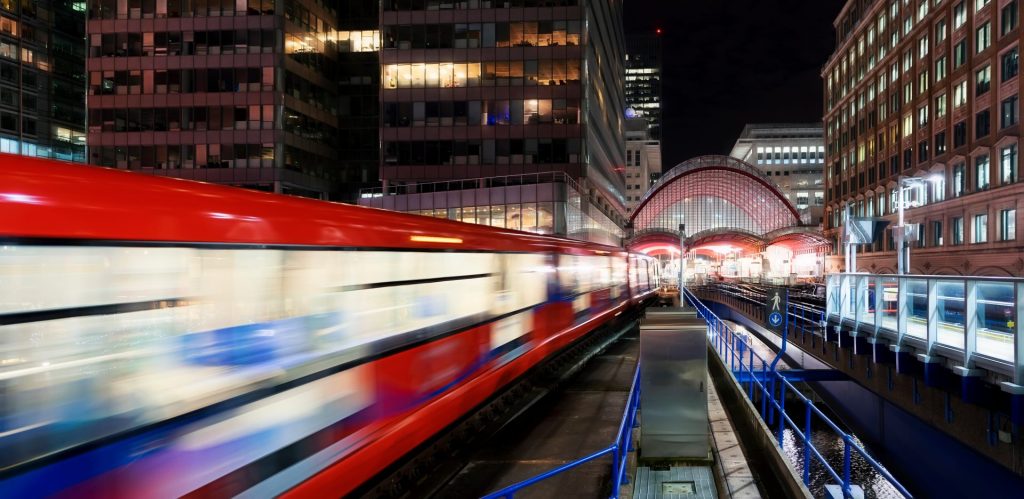 London Canary Wharf Station at night
Urban mobility policies in London
Demand management: Congestion Charge and Emission Zones
Congestion Charge
Inspired by Singapore’s Electronic Road Pricing (ERP) system after London officials had travelled to the country, the charge was first introduced on 2003. The London charge zone is one of the largest congestion charge zones in the world, despite the removal of the Western Extension which operated between February 2007 and January 2011. The charge not only helps to reduce high traffic flow in the city streets, but also reduces air and noise pollution in the central London area and raises investment funds for London’s transport system.
- Daily charge of £18 (if paid on or before the day of entry) to enter the central zone during daytime hours; £21 if paid later.
- Current hours: 7:00 a.m.–6:00 p.m. Monday to Friday and 12:00 p.m.–6:00 p.m. Saturdays, Sundays and public holidays.
- Objective: to reduce congestion by discouraging car use in the centre and funding public transport.
Low Emission Zone (LEZ) and Ultra Low Emission Zone (ULEZ)
- The LEZ (2008) covers almost all of Greater London and focuses on heavy vehicles.
- The ULEZ was introduced in 2019 in the city centre and has been expanding to cover the whole of London by 2023.
- Vehicles that do not meet Euro standards (emissions) pay a charge; the level of fines (PCN) has been raised (from £160 to £180 in 2023) to maintain the deterrent effect.
Key results of these measures
- The OECD highlights that, although congestion remains a challenge, CO₂ and air pollutant emissions have decreased and the proportion of clean vehicles has increased.
- The one-year report on the expanded ULEZ shows a notable drop in the number of older, highly polluting vehicles entering the zone and measurable improvements in NO₂ at many points.
 Evolution of electric and plug-in cars in the United Kingdom
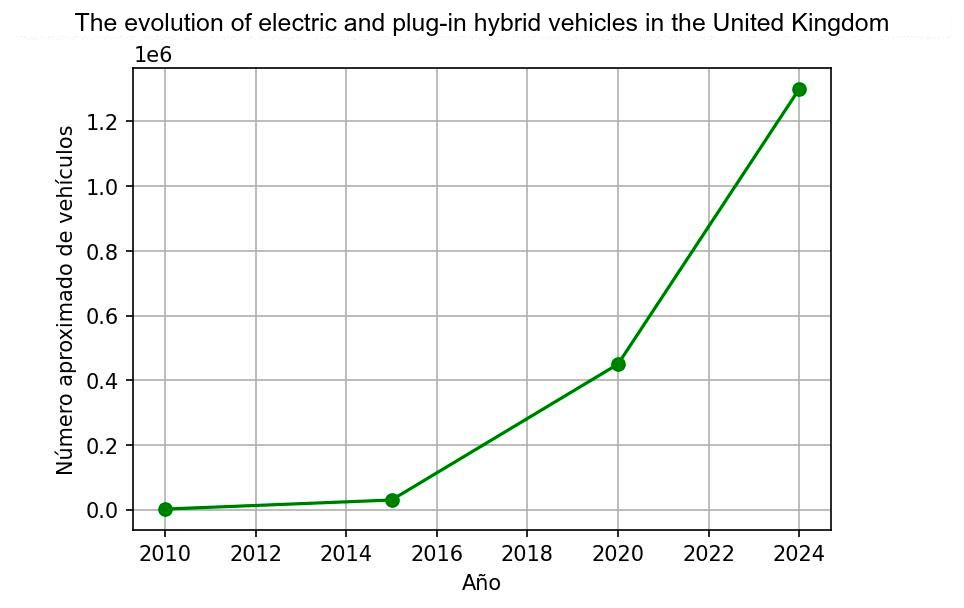 Evolution of electric and plug-in cars in the United Kingdom
Public transport: bus, underground and Superloop
Improvements to bus and underground services
- London has invested heavily in its bus network over many years, with bus lanes, priority at traffic lights and strong fare integration.
- The underground has been expanded and modernised, but for your report, the above-ground part (bus + lanes + priority) is more interesting.
Superloop (new express bus ring)
- Superloop is a network of orbital express bus routes that connect key suburban areas without passing through the city centre, with fewer stops and priority.
- It is part of the strategy to offer real alternatives to the car in the suburbs, where distances are greater and rail services do not always cover all routes.
Overall objective
- To increase the modal share of public transport and make it the “default” option in the city, even outside the city centre.
Active mobility: walking and cycling
London has gone from being a ‘hostile’ city for cycling to creating a growing network of cycle routes:
- Cycleways network (formerly Cycle Superhighways), with protected lanes in key corridors.
- Extensions of 20 mph zones, traffic calming in neighbourhoods and creation of ‘Healthy Streets’ environments for walking.
- Public bicycle service such as Santander Cycles (the popular ‘Boris bikes’), which marked a turning point in cycling culture.
These policies aim to improve public health, reduce emissions and also congestion: every short journey by bike or on foot that replaces a car journey frees up road capacity.
Micromobility (e-scooters, e-bikes)
Micromobility has grown significantly:
- London has authorised regulated trials of shared e-scooters and has developed specific strategies for integrating them into the transport system.
- Companies such as Lime have launched a London Action Plan with specific measures: funding for 930 new bike racks for e-bikes (increasing capacity by 40%), incentives in the app for parking properly, etc.
- Reports from think tanks such as the Centre for London highlight that, when well integrated, micromobility can reduce congestion and emissions, especially over short distances and as a feeder to public transport.
 Typical London buses and taxis
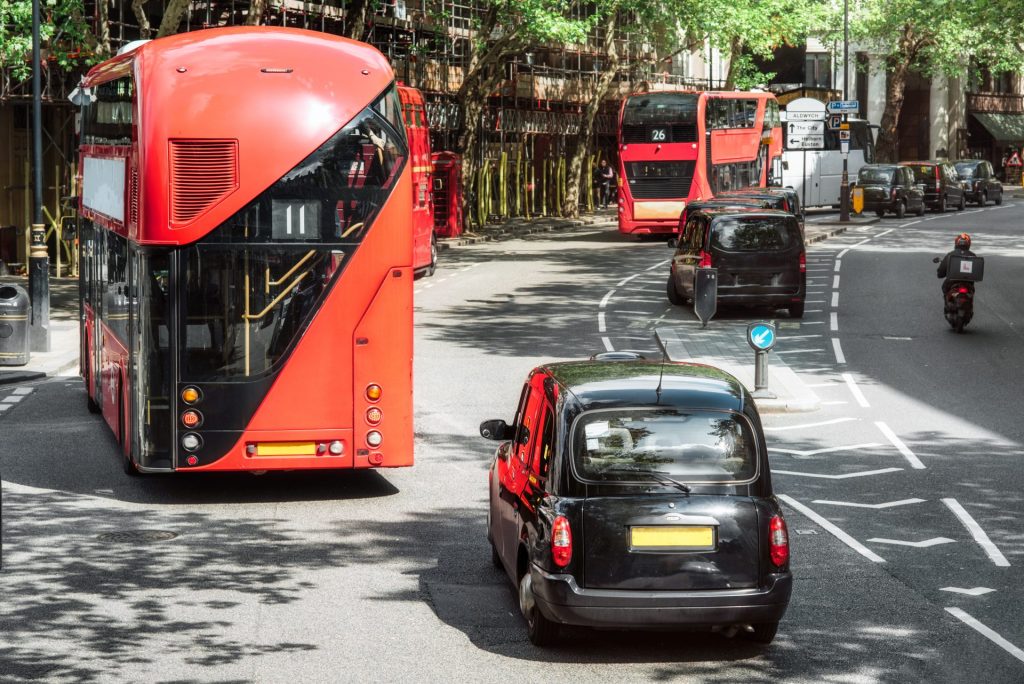 Typical London buses and taxis
Technologies and data: the ‘brain’ of London’s mobility
Payment systems and ‘de facto’ MaaS
- London pioneered the Oyster card and contactless payment (bank card or mobile phone) on buses, underground and trains.
- The fare is calculated automatically with daily/weekly capping, which is a very simple and powerful form of ‘Mobility as a Service’ (MaaS) without the user having to choose a product.
This reduces friction, makes public transport more attractive and allows the city to obtain very detailed usage data.
Open data and applications
- Transport for London (TfL) is famous for its open data policy, releasing real-time information on stops, waiting times, incidents, etc.
- This openness has fostered an ecosystem of mobility apps (route planning, traffic, arrival times) developed by third parties, which are very useful for users and for the digital economy.
Mobility intelligence and connected data
- Projects such as Road Intelligence for London Mobility (RILM) exploit data from connected vehicles to improve traffic management and align it with MTS objectives.
- Advanced analytics are used to:Identify bottlenecks and evaluate traffic light changesMeasure the real impact of new infrastructure or restrictionsSimulate future policy scenarios (e.g. changes to the Congestion Charge).
Micromobility and smart mobility technologies
- London is positioning itself as a hub for smart mobility, with testbeds for connected vehicles, urban logistics solutions, etc.
- Micromobility platforms (e-scooters, e-bikes) integrate:
- Geofencing (areas where you cannot drive or park); Real-time fleet management and Dynamic pricing models and incentives for good parking.
 Woman using London underground metro map
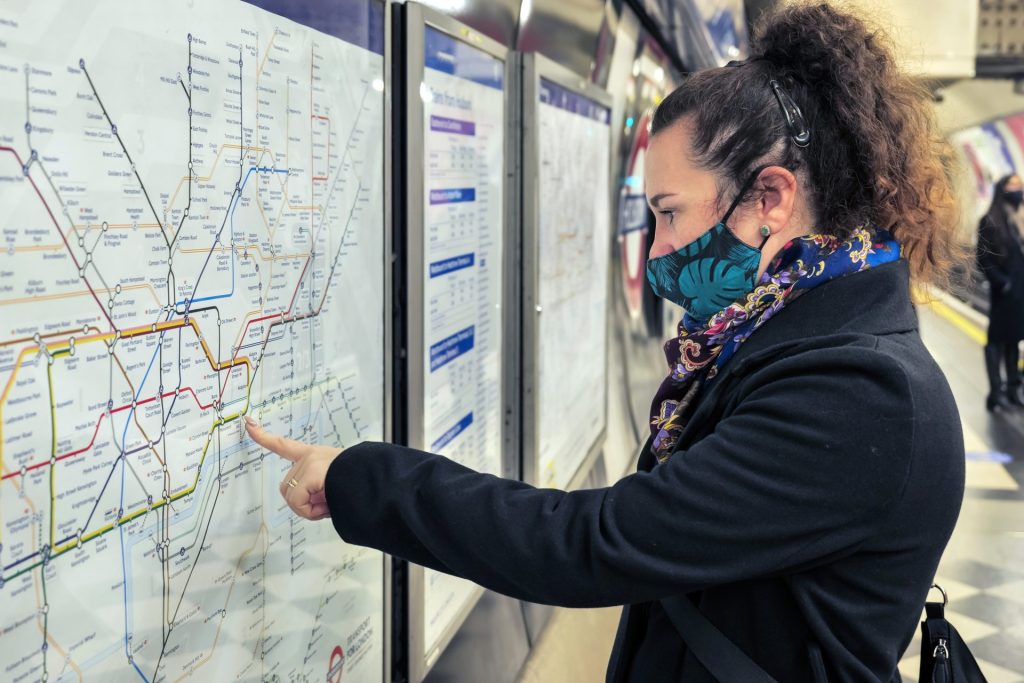 Woman using London underground metro map
Results: impact on traffic and mobility
Emissions and air quality
- The combination of Congestion Charge, LEZ and ULEZ has reduced CO₂ emissions and pollutants from transport in the central area and, following the expansion, throughout the city.
- Official reports point to a sharp drop in the number of highly polluting vehicles on the roads in London following the expansion of ULEZ.
Congestion and traffic volumes
- In the short term, the Congestion Charge achieved significant reductions in traffic in the centre; in the long term, the growth of the city and the reallocation of road space have meant that congestion remains a challenge.
- Key message: Congestion is better contained than in scenarios without measures, but it does not disappear, and many MTS targets would require further reductions in traffic volumes.
Modal split
- The MTS sets a target of 80% of journeys being made by sustainable modes; monitoring reports show progress, but not enough to reach the target without further measures.
Future targets and plans
Looking ahead, the key lines are:
- 80% of journeys by sustainable modes by 2041, with a particular focus on reducing private car traffic and car dependency in the suburbs.
- Zero emissions:Greater penetration of zero-emission vehiclesFull electrification of the TfL bus fleet.
- Extend and improve Superloop and the bus network to provide competitive alternatives to the car in suburban areas.
- Strengthen active mobility through more “Healthy Streets”, safe cycle lanes and speed reduction.
- Evolution of road pricing: the transition from separate schemes (Congestion Charge, ULEZ) to more comprehensive road user charging models is being discussed, potentially based on kilometres, vehicle type, time and zone, supported by technology and data.
123 Buckingham Palace Road – London SW1W 9SR
About Vectio
At Vectio, we focus on effective sustainable mobility planning; we are experts in this field. Throughout our nineteen years of existence, we have always maintained an innovative approach, investing in the technological resources most demanded by our clients. We firmly believe that, after more than 1,500 successful projects, what sets us apart from any other company in the sector is our use of the best technology for capturing and analyzing traffic and mobility data.