

On April 13, when Easter Holidays began, one of the most important Festivals of National and International Tourist Interest of the traditional culture in Spain, also started one of the times of the year in which more displacements are produced in the country. For this year 2025, more than 15.8 million road trips are expected, a figure 2.4% higher than that of 2024, according to the DGT (General Direction of Traffic) which began with the Easter Special Operation on Friday 11. The second phase, Operation Exit, will begin on Wednesday 16 and end on April 21, where more than 4,230,000 million vehicle trips are estimated, the figure reached in the first phase. The most important Easter celebrations, and consequently, where the largest concentrations of people are expected, are located in the autonomous communities of Castilla León, Andalucia, Valencia and Castilla La Mancha, among others, being the Holy Week of Badajoz, the last festivity to be named of International Tourist Interest.
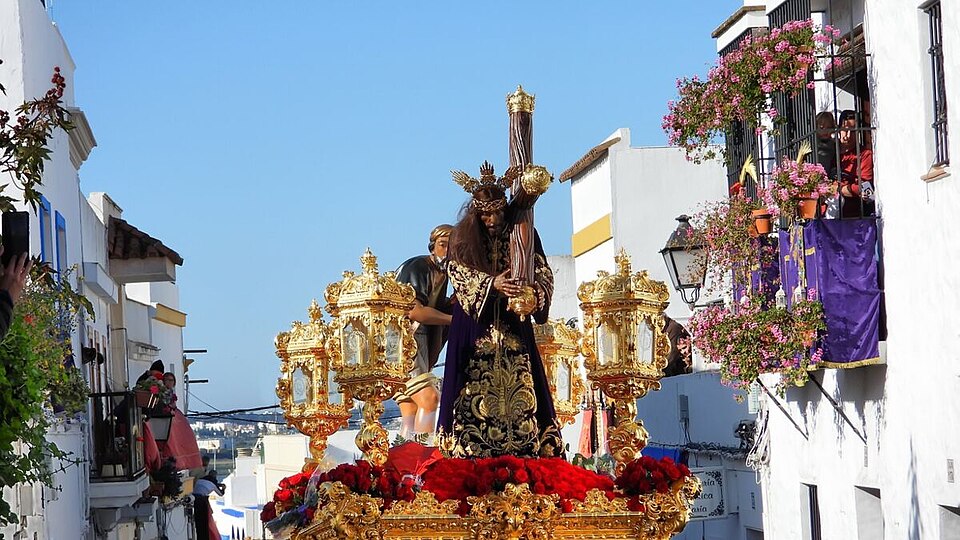 Procession of Our Father Jesus of Nazareth
The Easter holiday period becomes for some the perfect time to make that pending trip, those who decide to take the suitcase and escape from their routine. But for many others, the passion for the brotherhoods, the processions and the customs become reason enough to live this religious festivity in their own city. Therefore, we find ourselves before two different situations of mobility, one of long distance travel, either by road or other means (interurban mobility), and another located in the municipality itself (urban mobility), which in both cases lead to the need to implement proper mobility plans. People actively participate in the events and traditions, which can last all day and well into the night, but… Have we really stopped to think about how these festivities affect the daily mobility of residents? Why are mobility plans implemented? What are the main objectives of designing a proper mobility plan? What actions are carried out to properly regulate traffic?
Some of its objectives are the reduction of traffic congestion, the improvement of road safety and accessibility of citizens to the different spaces, the promotion of the use of public transport and the intermodality of the different means of transport and the optimization of their infrastructure. The DGT also participates in these plans. Another of its indications is to implement between April 11 and 21, in order to ensure a good fluidity in road circulation, the restriction of the circulation of vehicles transporting goods of more than 7,500kg of M.M.A, transport of dangerous goods and vehicles that require special authorization, as well as limitations to the celebration of sporting events. Such is the importance of the design of these mobility plans, that the City Councils and the different local newspapers announce in advance these changes in traffic and transport to their citizens, serving as examples the actions of the mobility plans of Seville, Malaga or Toledo.
Long queues of vehicles at the exit of a city, a typical scene during Easter Holidays in Spain.
Crowded traffic solution: Forecast of the use of means of transport during Easter Holidays
CONFEBUS (Spanish Confederation of Bus Transport), estimates that almost 6.2 million trips (39% of total trips) will be made by bus, an increase of more than 2% over last year. In addition, bus companies will reinforce their services on these dates by more than 40%. Regarding rail transport, more than 12,365 high-speed, medium and long distance trains will run throughout the rail network of our country during this Easter, according to ADIF data. By stations, only from the two in Madrid (Atocha and Chamartin) will depart and arrive a total of 4,440 trains and the Santa Justa train station in Seville, is preparing to record a total of 961 arrivals and departures over the next few days. This Andalusian community accounts for nearly 8% of the total supply of rail transport.
Already in 2024, Renfe announced an increase of 79,569 extra seats in Ave and Larga Distancia services and a reinforcement in Media Distancia and Avant trains of 836,685 seats in services for trips to closer locations. The reinforcement of public transport lines in the different means of transport has become a key solution for the management of crowds in cities. As an example we have the special device carried out by the Community of Madrid that at certain times will increase the number of trains on some lines, up to 125%. Metro de Madrid has announced that Sol station will remain closed from 16:30 until the end of the service, to avoid high concentrations. All these measures are designed to guarantee and facilitate mobility during the celebration of the processions.
In any case and regardless of how you have planned your Easter Week, do not forget to consult the information offered by the different organizations and institutions that will help you to organize it in the safest way possible.
In Vectio | Traffic & transport planning we are specialists in mobility planning since 2007.
Links:
https://www.spain.info/es/descubrir-espana/semana-santa-espana-destinos-mejores-fiestas/
https://vectio.es/servicios/planes-movilidad/
https://www.transportes.gob.es/el-ministerio/sala-de-prensa/noticias/vie-11042025-1246
https://www.transportes.gob.es/el-ministerio/sala-de-prensa/noticias/vie-11042025-1246