

Latin American cities face a common challenge: how to respond to urban growth, reduce congestion, improve air quality and offer more efficient and inclusive transport alternatives. Against this backdrop, the city of Puebla (Mexico) has become an interesting laboratory for urban innovation thanks to a combination of public investment, international cooperation and specialised technical assistance. In recent years, various international organisations, development banks and cooperation agencies have supported projects ranging from cycling to the modernisation of public transport, including road safety, the electrification of vehicle fleets and new mass transit systems. Although significant challenges remain regarding funding, modal integration and the measurement of results, Puebla is building a portfolio of initiatives that can serve as a benchmark for other medium-sized cities in Latin America.
International cooperation as a catalyst for change
One of the most interesting findings when analysing Puebla’s recent development is that international cooperation has not merely acted as a source of funding. In many cases, its greatest value has been in providing technical expertise, planning methodologies, monitoring tools and institutional capacities that enable local authorities to design more robust and scalable projects. Key international actors active in Puebla include:
- European Union (EUROCLIMA+)
- French Development Agency (AFD)
- German Development Cooperation (GIZ)
- German Development Bank (KfW)
- Institute for Transportation and Development Policy (ITDP)
- International urban cooperation organisations
These actors are involved at various levels, ranging from the direct funding of pilot projects to specialised technical assistance for the design of public policies.
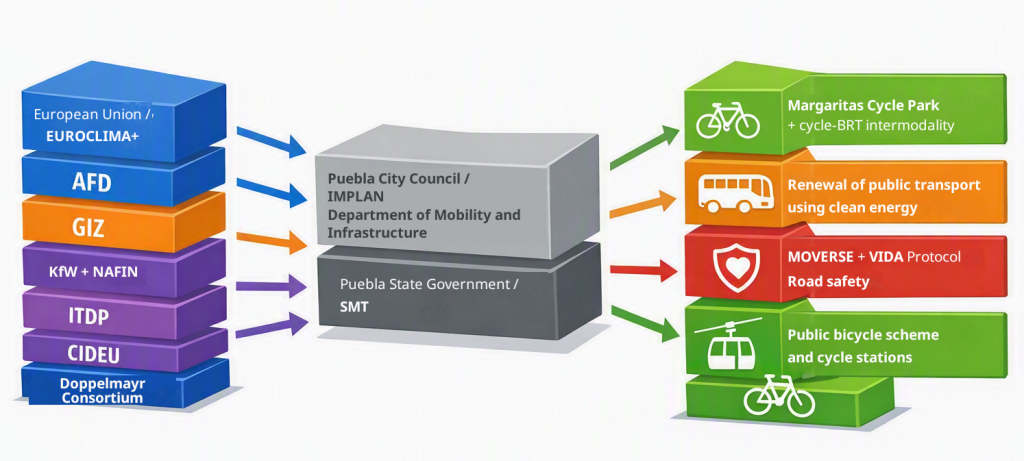
An overview of international stakeholders, local/state authorities and sustainable mobility projects identified for Puebla.
Comparative inventory of projects
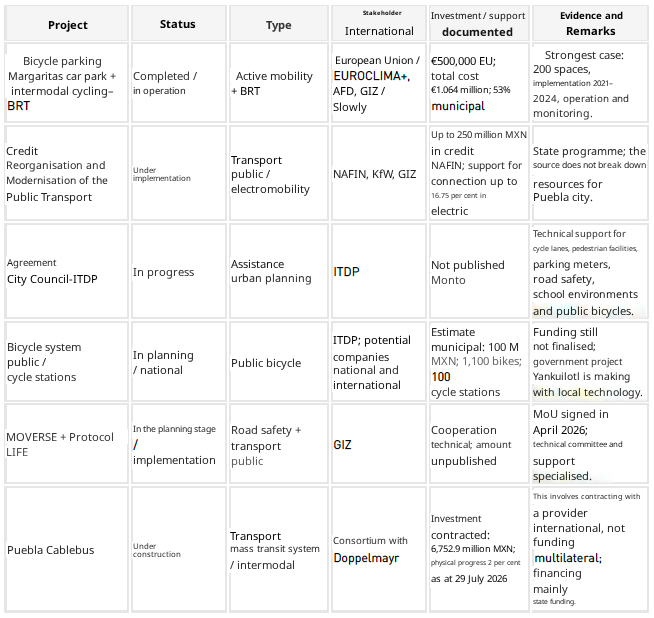
The flagship project: Margaritas Terminal Mass Cycle Park
If there is one project that exemplifies the positive impact of international cooperation in Puebla, it is the Margaritas Terminal Mass Cycle Park.
The initiative arose as part of the EUROCLIMA+ programme, funded by the European Union and receiving technical support from the French Development Agency (AFD).
Its objective was simple yet transformative: to facilitate intermodality between cycling and the RUTA public transport system, reducing reliance on private cars and promoting low-emission travel.
Key results
- 200 bicycle parking spaces.
- Direct integration with RUTA Line 2.
- Nearly 4,000 registered users during its first year of operation.
- 43 per cent of registered users were women.
- Free of charge for the public.
The total documented investment amounted to 1,064 million euros, of which 500,000 euros were contributed by the European Union, whilst the remainder came from municipal funds.
Modernisation of public transport: the commitment to electromobility
Whilst the Margaritas project represents a well-established initiative, Puebla is also making progress in the renewal of its public transport system through international financial cooperation schemes.
One of the most significant programmes involves:
- Nacional Financiera (NAFIN)
- German Development Bank (KfW)
- German Cooperation (GIZ)
The aim is to facilitate the gradual replacement of old vehicles with more efficient ones that produce lower emissions. The programme provides for credit facilities of up to 250 million pesos, as well as incentives to encourage the purchase of electric vehicles and low-emission technologies. Beyond the financing itself, the involvement of KfW and GIZ brings international expertise in energy transition and sustainable mobility, a key factor in ensuring that the investments yield lasting results.
 Callejón de los Sapos in the colonial quarter of Puebla.
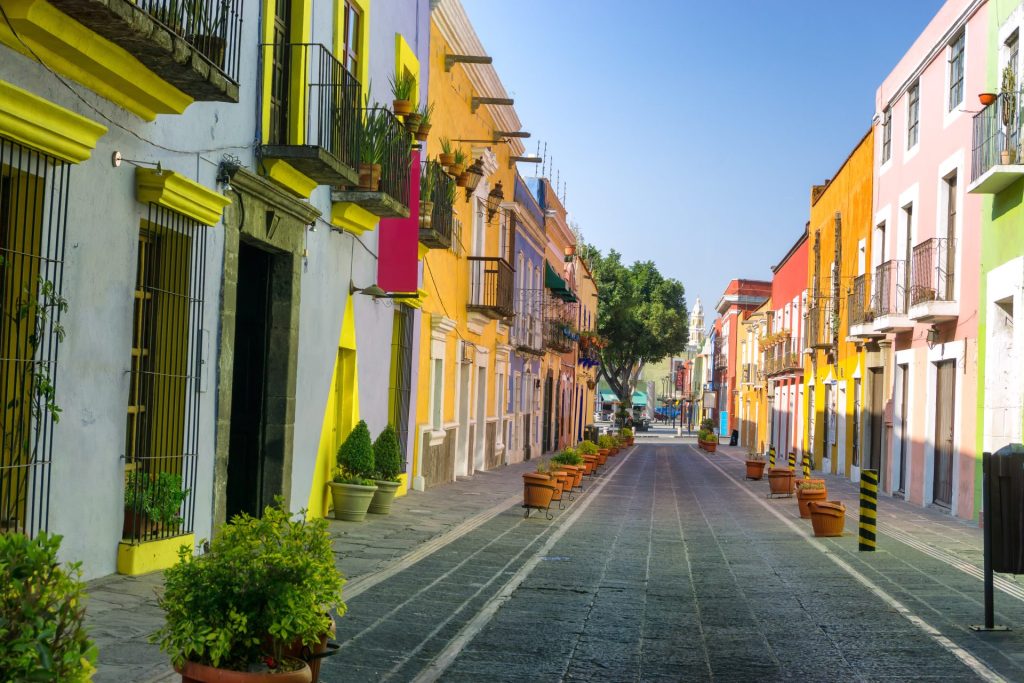 Callejón de los Sapos in the colonial quarter of Puebla.
Road safety and inclusive mobility: the role of GIZ
In April 2026, Puebla took a further step by signing a memorandum of understanding with German Cooperation (GIZ) as part of the MOVERSE programme.
This initiative aims to strengthen:
- Road safety.
- The quality of public transport.
- Universal accessibility.
- Inclusive mobility.
- Sustainable urban planning.
One of the most interesting components is the development of the so-called VIDA Protocol, a strategy designed to reduce road accidents through training, technical assistance and new management methodologies.
Although it is still too early to measure concrete results, the project reflects a clear trend: sustainable mobility is no longer limited solely to infrastructure, but incorporates aspects of safety, equity and service quality.
ITDP and the creation of a more walkable and cycle-friendly city
Another international organisation with a significant presence in Puebla is the Institute for Transportation and Development Policy (ITDP).
Through an agreement signed with the City Council, this organisation is collaborating on:
- Cycling infrastructure.
- Pedestrian spaces.
- Parking management.
- Road safety.
- Safe school zones.
- Public bicycle schemes.
The importance of this cooperation lies in the transfer of knowledge accumulated across dozens of cities around the world.
International best practices help to avoid common mistakes and accelerate the implementation of projects with a higher likelihood of success.
New projects in the planning stage
Puebla is not only working on projects that are currently operational or under way. It is also developing initiatives that could redefine urban mobility over the next decade.
Public bicycle system
The City Council is considering the creation of a bike-sharing scheme comprising:
- 1,100 bicycles.
- 100 bike stations.
- An estimated investment of 100 million pesos.
The project is currently seeking funding mechanisms and potential institutional partnerships.
Puebla Cablebus
The most ambitious initiative currently underway is the future Puebla Cablebus.
The project envisages:
- A 14.58-kilometre route.
- 9 stations.
- Intermodal transfer hubs.
- Potential benefits for over 700,000 people.
The planned investment exceeds 6,700 million pesos, making it one of the largest transport projects in the city’s recent history.
Although the main funding comes from the state, the involvement of specialised international companies brings technology and experience gained from similar projects around the world.
What lessons can be learnt from the case of Puebla?
Puebla’s experience shows that international cooperation can play a decisive role in transforming urban transport.
Three conclusions stand out in particular:
1. Pilot projects generate learning
The case of the Margaritas Bike Park demonstrates that a relatively modest investment can produce concrete results and lay the foundations for future interventions.
2. Technical assistance is just as important as funding
Organisations such as ITDP, GIZ and AFD provide methodologies, knowledge and institutional capacity that endure even after projects have been completed.
3. Integration will be the key to success
Puebla’s true potential lies not in individual projects, but in the ability to integrate public bicycle schemes, cycle lanes, mass transit, fleet electrification, road safety and the Cablebús system within a single urban mobility strategy.
 The Church of Los Remedios in Cholula (Puebla state), with the Iztaccíhuatl volcano (5,220 m) in the background.