

On 8 October 2025, the Spanish Congress of Deputies approved the long-awaited Sustainable Mobility Law, a key piece of legislation for advancing the decarbonisation of transport, meeting European climate commitments and reconfiguring the mobility system in Spain. However, the law raises substantial doubts regarding its degree of future development, financing, implementation deadlines, and the participation of all the administrations involved in its implementation. The law has come into being after years of delays and intense political negotiations, conditioned in part by the need to unlock more than €10 billion in European funds from the Recovery Plan. Below is a reasoned, point-by-point analysis of its content, strengths, weaknesses and comparison with regulatory frameworks in other European countries.
Main objectives of the Law
The law is based on several key principles:
- Mobility as a basic, accessible, sustainable and safe right.
- The reduction of emissions from transport (one of the most polluting sectors).
- The promotion of public, collective, active and low-emission transport.
- The closing of gaps between urban and rural areas.
- Coordination between public administrations on mobility policies.
This is a framework law that establishes general guidelines, leaving many details to future regulatory developments and the action of autonomous communities and local authorities.
Ten key points and critical analysis
1. Mobility as a right
For the first time, the law recognises sustainable mobility as a right of citizens, something that has strong symbolic and normative value. However, it lacks clear legal mechanisms to enforce this right in court, which limits its practical effect if it is not provided with additional resources and guarantees.
👎🏼 It may remain a declarative principle with no real application if regulations or budgets are not developed to make it effective.
2. Mandatory mobility plans for companies
It is established that, within two years, companies with more than 200 employees (or 100 per shift) must submit a sustainable mobility plan for the workplace. These plans must promote the use of public transport, car sharing, cycling or teleworking.
👍🏼 It involves the private sector in reducing emissions and congestion.
👎🏼 Lack of technical and financial support for its implementation, especially in areas with poor connectivity.
3. Limitation of domestic flights
One of the most talked-about points: domestic flights are prohibited when there is a competitive rail alternative (less than 2.5 hours duration), except in justified cases. Night trains are also being promoted as a medium-distance alternative.
👍🏼 Contributes to the decarbonisation of short-haul air transport.
👎🏼The railway must be able to meet demand (frequencies, prices, coverage).
4. Review of vehicle environmental labelling
The current DGT environmental labelling system will be reformed to be based more on actual CO₂ emissions and not just on the type of engine (hybrid, electric, etc.).
👍🏼 Improves the environmental consistency of the system.
👎🏼 May cause confusion and legal uncertainty if changes are applied retroactively or poorly communicated.
5. Commitment to rural mobility
The law stipulates that the State shall assume responsibility for providing minimum transport services in rural areas if the autonomous communities fail to do so, with the aim of curbing the isolation of what is known as ‘depopulated Spain’.
👍🏼 Contributes to territorial cohesion and guarantees basic rights.
👎🏼 Financial sustainability and coordination with other levels of government.
6. Socio-environmental assessment of infrastructure
Before implementing new transport infrastructure, a social and environmental cost-benefit analysis, not just an economic one, will be mandatory.
👍🏼 Prioritises useful and sustainable investments.
👎🏼 May be interpreted subjectively if strict and transparent criteria are not defined.
7. Regulatory testing areas (“sandboxes”)
The law introduces a framework to allow controlled regulatory experiments with new mobility technologies (autonomous vehicles, drones, etc.) in designated areas and under supervision.
👍🏼 Promotes technological innovation and legal adaptation.
👎🏼 Possible legal loophole if not accompanied by adequate monitoring and clear rules.
8. Governance and newly created bodies
Several coordinating bodies are created, such as:
- The Higher Council for Sustainable Mobility
- The Administrative Mobility Forum
- The National Mobility Data Space
Their function is to coordinate policies and share data between administrations.
👎🏼 They are mostly advisory bodies with no executive power, which could limit their actual effectiveness.
9. Insufficient funding and no timelines
One of the most widespread criticisms is that the law does not include specific deadlines for implementing many of its measures, nor does it establish a specific funding system for the new obligations.
👎🏼 Without funds or dates, the measures may be paralysed or diluted over time.
10. Political conditions and concessions
The approval of the law depended on sensitive political agreements. Podemos facilitated the vote in exchange for postponing the expansion of El Prat airport until after 2031, removing it from the state investment plan. This shows how infrastructure interests and environmental commitments can come into tension within the governing coalition itself.
 Santa Justa railway station (Seville).
International comparison
Spanish law is in line with other similar regulations approved in Europe in recent years, although it has some shortcomings.
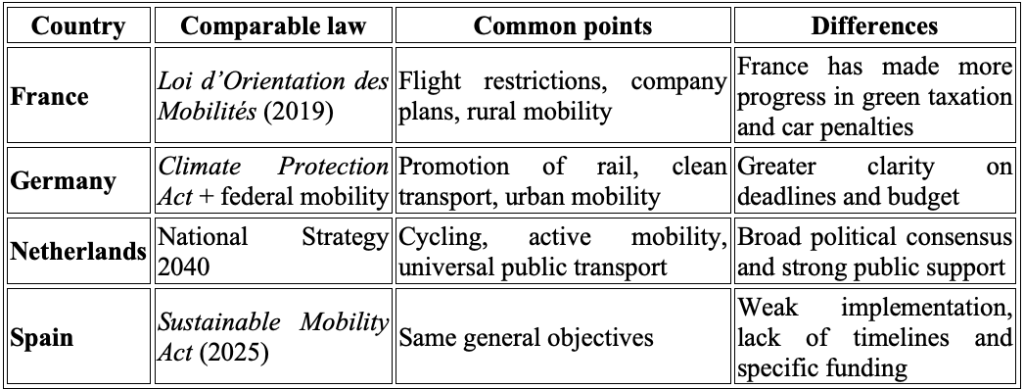
Spain’s Sustainable Mobility Act (2025) and France’s Loi d’Orientation des Mobilités (LOM) (2019) share a common strategic approach, but differ significantly in terms of ambition, fiscal approach and degree of implementation.
Key similarities (fundamental similarities)
1. Recognition of mobility as a right. Both laws declare that mobility is a fundamental right and must be guaranteed in an accessible, safe and sustainable manner.
2. Mandatory mobility plans in companies. In both France and Spain, medium and large companies must implement sustainable mobility plans for commuting to work.
3. Restriction on short domestic flights. France has banned domestic flights if there is a train alternative of less than 2h30 (effective from 2023). Spain has approved an identical measure, also with the same threshold (2h30).
4. Promotion of public and collective transport. Both laws seek to improve the provision and efficiency of public transport, especially in peri-urban and rural areas.
5. Decarbonisation and ecological transition of transport They share the goal of reducing greenhouse gas emissions in line with the commitments of the European Green Deal.
Key differences (design, implementation, ambition)
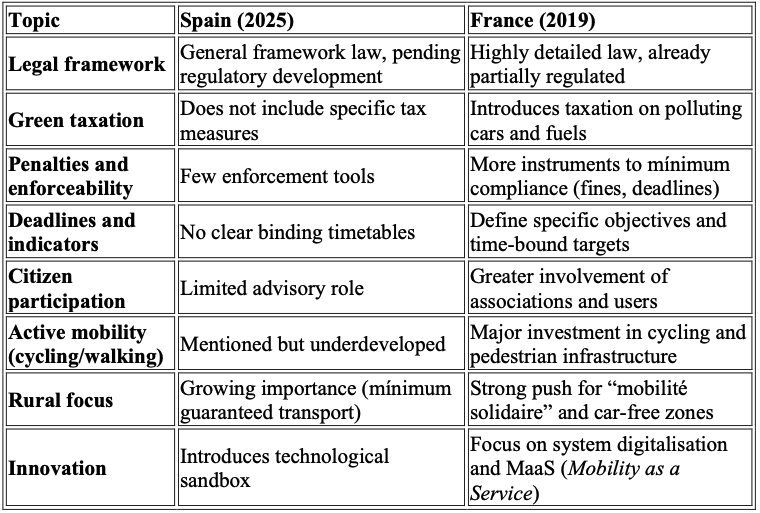
Comparative assessment
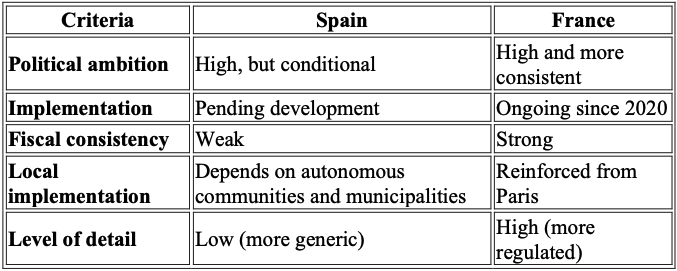
Both regulations are similar in philosophy, but the French LOM is more ambitious, specific and binding. The Spanish law has yet to prove its practical effectiveness through regulations, funding and effective enforcement. The French law, meanwhile, has already served as a model for other countries and has made progress in transforming the transport system.
- Spain has adopted a similar vision, but with fewer executive tools for now.
- France opted from the outset for a combination of incentives, penalties and green taxation, which has accelerated its implementation.

Conclusions
The Sustainable Mobility Act represents a necessary and courageous step forward in the transformation of the Spanish transport model. It incorporates innovative principles, obliges the private sector to get involved, and establishes a coordinated institutional framework.
However, its transformative potential depends largely on how it is implemented: it needs budgetary resources, clear regulations, defined timetables and constant political will. Otherwise, it risks remaining a declaration of intent that does not translate into real change for citizens.
Furthermore, its dependence on political agreements, as well as the absence of strong fiscal measures or sanctioning mechanisms, leaves gaps that will need to be resolved in the short term.
In a context of climate emergency and European pressure, this law could be a historic opportunity to move towards fairer, safer and decarbonised mobility. But like any framework law, its success depends not so much on what it says, but on how it is implemented.
About Vectio
At Vectio, we focus on effective sustainable mobility planning; we are experts in this field. Throughout our eighteen years of existence, we have always maintained an innovative approach, focusing on the technological resources most demanded by our clients. We firmly believe that, after more than 1,500 successfully completed projects, what sets us apart from any other company in the sector is our use of the best technology for traffic and mobility capture and analysis.