

South Africa is undergoing a complex transition towards more integrated urban transport systems, with uneven progress across metropolitan areas: Cape Town is accelerating the expansion of its BRT MyCiTi (Phase 2A); Johannesburg is revitalising Rea Vaya with the opening of Phase 1C (CBD–Alexandra–Sandton route); Durban (eThekwini) is attempting to ‘get GO!Durban back on track’ after a decade of delays. Meanwhile, the commuter rail network (PRASA/Metrorail) is experiencing a partial recovery from post-pandemic lows and vandalism, but remains far from the levels seen in 2014/15. All this against a backdrop of heavy reliance on the minibus-taxi as the “backbone” of daily mobility, high road accident rates and a national policy that is beginning to focus on decarbonisation (Electric Vehicles White Paper).
Key challenges
System fragmentation and reliance on minibus-taxis
Minibuses dominate the modal split in urban areas, but their informal nature (cash payments, governance by local associations) leads to coordination issues, safety risks and difficulties in integrating fares/data with formal transport modes. Recent studies document efficiency losses due to route segmentation between associations in Johannesburg and highlight the need to digitise fares and formalise labour relations.
Deterioration and safety of the metropolitan railway
PRASA has reopened 35 of 40 corridors and almost doubled passenger numbers to 77 million by 2024/25 thanks to investments of R21.1 billion; however, vandalism, insufficient rolling stock and bottlenecks on critical corridors (such as the Central Line in Cape Town) continue to limit service and its punctuality/reliability.
Uneven progress of BRTs
- MyCiTi (Cape Town): Phase 2A is currently the country’s largest public transport project; the 2024–2038 plan envisages expanding capacity and connectivity, but requires financial sustainability and careful sequencing of works.
- Rea Vaya (Johannesburg): Phase 1C reopens after a decade of delays; some stations remain unfinished and the history of delays (and stoppages) is eroding user confidence.
- GO!Durban (eThekwini): multiple postponements, cost overruns and conflicts with the taxi sector; in 2025, the municipality approved a new ‘tactical’ plan to launch services in mixed traffic while dedicated lanes are completed.
Road accidents and personal safety
South Africa continues to have high road fatality rates; the Ministry reported 10,154 deaths in 2024, with incidents concentrated at weekends and during night-time hours according to RTMC reports. The vulnerability of pedestrians and users of informal transport in urban peripheries exacerbates the problem.
Energy vulnerability and transport operations
Improved performance by Eskom in 2025 significantly reduced episodes of ‘load shedding’, but seasonal risks and medium-term supply adequacy risks persist (phase-out of coal-fired capacity by 2029–30). Power instability affects ticket offices, signalling, automated fare collection and station security.
 Durban coastal panorama
Strategies underway
Passenger rail modernisation
PRASA is implementing a modernisation plan involving the renewal of the EMU fleet, the refurbishment of stations and signalling, and a transit-oriented development (Intersite) agenda to generate revenue and stimulate demand. Targets for 2024/25: 35/40 operational corridors, 313 refurbished stations and commercial revenue of 708 million rand.
BRT expansion and integrated networks
- MyCiTi Phase 2A: multi-year investment (R5.4 billion in the local MTEF) to connect Khayelitsha/Mitchells Plain with Claremont/Wynberg; new stops/works (bridges, “Sky Circle”) and a business plan for 2024–2038.
- Rea Vaya Phase 1C: 13–15 new stations, 68–141 low-floor buses, pedestrian/cycle walkways and new Selby depot; objective: to relieve the Alex–Sandton corridor.
- GO!Durban: “Tactical Adjustment Roadmap” to integrate existing contracts, AFC and a single smart card, with greater taxi inclusion and a phased roll-out.
Minibus-taxi sector reform
The Taxi Recapitalisation Programme is being refocused: removal of illegal panel vans, automatic payment pilots and conversion to LPG (estimated fuel savings of ~35%) as a technological transition, alongside partner apps and 24/7 service centres.
Electrification and decarbonisation policies
The Electric Vehicles White Paper (2023) sets out the roadmap for producing EVs locally without deindustrialisation, aligned with SAAM 2035; in 2025–26, sector-specific policy briefs and market intelligence proliferate to accelerate charging infrastructure, incentives and supply chains (batteries).
High-speed rail mega-projects (Gauteng)
The expansion of the Gautrain (up to +150–300 km) returns to the agenda for 2024–26: route decisions in 2025 (Soweto, Fourways, Mamelodi, Lanseria, etc.) and transfer of the asset to the provincial government to restart phases from 2026. There is an ongoing debate regarding costs and subsidies, as well as post-COVID demand.
 View of the suburb of Sandton, in Johannesburg, one of the areas with the highest per capita income in all of Africa
 View of the suburb of Sandton, in Johannesburg, one of the areas with the highest per capita income in all of Africa
Challenges to be overcome
Multilevel governance and sustainable financing
Functional decentralisation (such as the potential ‘devolution’ of Metrorail to Cape Town) is progressing amidst political tensions and the need for long-term operating and investment subsidies.
Fare/technological integration
Scaling interoperable AFC between BRT, rail and taxis requires standards, revenue-sharing agreements and data security; reliance on cash in taxis remains a key barrier.
Safety (road and personal)
Reducing fatalities to below 10,000 per year and improving “subjective safety” at transport hubs requires strengthening comprehensive measures, safe street redesign and campaigns focused on pedestrians.
Energy and operational resilience
Although Eskom improved in 2025, the 2029–30 ‘cliff’ and the variability of EAF necessitate equipping critical systems (signalling, ticketing, depots) with backup and energy efficiency measures.
Procurement and social acceptance
Conflicts with taxis on the BRT and employment concerns at PRASA require fair transition agreements (recruitment, retraining, revenue sharing) and sustained communication.
Future objectives (2030–2035 horizon)
- Restore the metropolitan railway as a high-capacity backbone: expand reopened corridors, improve punctuality, enhance safety and rolling stock, and consolidate TOD to capture value and demand.
- Complete and stabilise BRT in the three major metropolitan areas, with operational priority (lanes, traffic lights, control), physical integration with taxis and NMT, and sustainability plans (capex/opex).
- Formalise and hybridise the minibus-taxi: licences, safety standards, cashless payment, open operational data and pilot schemes for alternative fuels (LPG/light EVs) where feasible.
- Decarbonise fleets (public and urban service) by leveraging the EV White Paper, selective incentives and resilient charging hubs (solar + storage), prioritising high-demand corridors.
- Gauteng Vision 2030+: realistic phases of Gautrain linked to demand and land-value capture, with transparent cost-benefit analysis and subsidies.
Different urban mobility strategies in South Africa
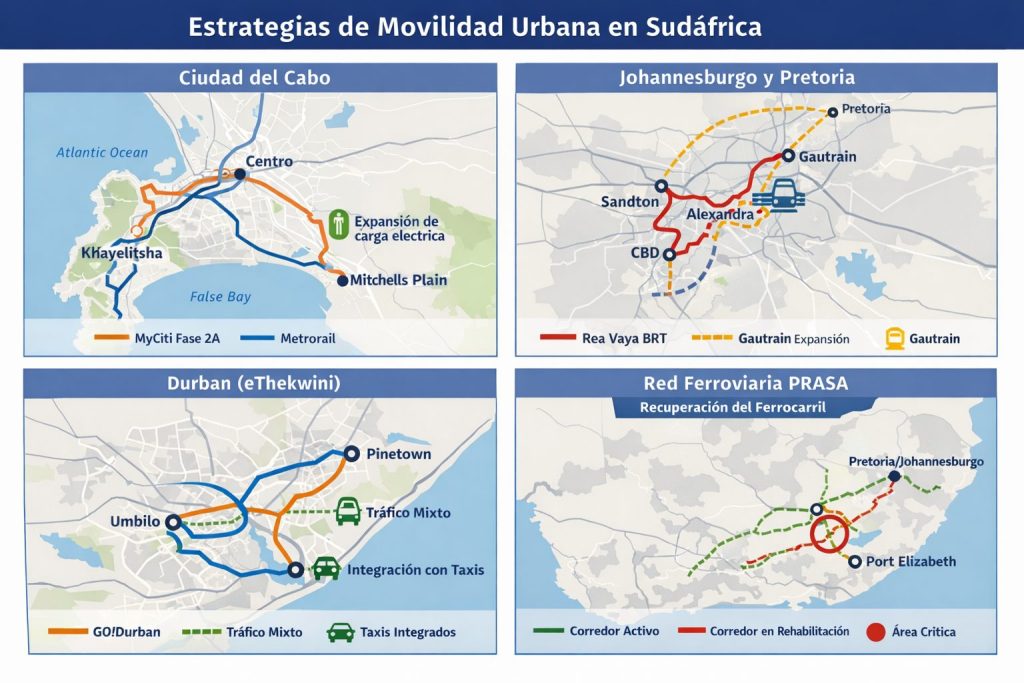 Different urban mobility strategies in South Africa
Alignment with the economic and geopolitical context
- Urban productivity and employment: Mobility determines productivity in the two largest metropolitan economies (Gauteng and Western Cape). Recent electrification improvements are aiding the recovery of services, but the 2026–2030 window is critical for consolidating investments and avoiding energy bottlenecks.
- Industrial and export competitiveness: The EV White Paper aims to safeguard the automotive cluster (2.9% of GDP, representing over 200 billion rand in exports in 2022) in the face of decarbonisation in destination markets (EU/UK). Electrified urban mobility (buses, municipal fleets, last-mile logistics) is a driver of local demand and technology markets.
- Country risk and infrastructure investment: Major projects (Gautrain, BRT Phase 2A) drive CAPEX and employment, but are subject to fiscal discipline, governance and social acceptance; the GO!Durban case highlights the costs of delays and institutional gridlock.
- Global trends and climate: Alignment with net-zero emissions targets and climate finance (just energy transition) can channel resources if urban mobility projects demonstrate emissions reduction, social inclusion and transparency.
Executive recommendations
Accelerate fare integration across major metro areas (CoCT/CoJ/eThekwini) with interoperable AFC specifications and clearing rules between BRT–rail–taxi; accompany this with incentives for the adoption of cashless payments in taxis.
“Safe mobility” packages: redesign of urban black spots (lighting, cameras, police presence) and speed management at BRT access points/Metrorail stations, prioritising corridors with the highest accident rates and demand.
Operational energy resilience: microgrids at key depots and stations (photovoltaic + BESS) for AFC, signalling and security; prioritise the most critical PRASA and BRT nodes.
Just transition of the taxi sector: service contracts, minimum labour standards, fleet renewal conditional on safety, and LPG/EV pilot schemes with total cost of ownership and emissions metrics.
Governance and accountability: public progress dashboards (capex, timelines, demand) for MyCiTi Phase 2A, Rea Vaya 1C and GO!Durban, with milestone audits and early dispute resolution mechanisms.
Panoramic view of Cape Town at dusk
 Panoramic view of Cape Town at dusk
Key evidence by city
Cape Town (MyCiTi)
- CITP 2023–2028 (2024/25 update) sets out vision, objectives and transport register; Phase 2A is the largest public transport investment in the country; works, new stops and business plan 2024–2038.
Johannesburg (Rea Vaya + Gautrain)
- Rea Vaya 1C operational in 2025 with 13–15 stations and pedestrian/cycle bridges; challenges due to historical delays and industrial action.
- Gautrain: route finalisations in 2025 (Soweto, Fourways, Mamelodi, Lanseria), with expansion plans from 2026 onwards and debate on subsidies and demand.
eThekwini/Durban (GO!Durban)
- After 11 years, the municipality agrees on a phased approach: integrating existing contracts, AFC and smart card, and launching in mixed traffic whilst dedicated lanes are completed; still faces criticism over spending on unused stations and conflicts with taxis.
Metropolitan Rail (PRASA)
- 77 million passengers (2024/25), 35/40 corridors in operation, R21.1 billion in capex; vandalism and the fleet remain bottlenecks; in the long term, a need to close the gap with 2014/15.
Conclusion
South African urban mobility is at a turning point: if cities consolidate rail modernisation, complete their BRT systems with operational priority, and manage to integrate the minibus sector with digital payments and service standards, the country can reap economic (productivity, employment), social (accessibility, safety) and climate (lower emissions) benefits. The risk is another decade of fragmentation and underutilised infrastructure. The opportunity: to align mobility, energy and industrial policy (EVs) so that metropolitan areas can drive inclusive growth.
In 2026, South Africa became the 38th international market in which Vectio Traffic Engineering has carried out mobility and transport projects, consolidating its presence on the African continent.
About Vectio
At Vectio, we focus on the effective planning of sustainable mobility; we are experts in this field. Throughout our nineteen years in business, we have always maintained a commitment to innovation, investing in the technological solutions most sought after by our clients. We firmly believe that, having successfully completed over 1,500 projects, what sets us apart from any other company in the sector is our use of the best technology for traffic and mobility data collection and analysis.