

The year 2022 marked the settlement of the new normal after the pandemic caused by COVID-19, which greatly affected the mobility and transportation sectors, but also marked the beginning of a transformation towards a more digital economy and a more sustainable world. Now we take a look back to analyze the evolution of the transformation measures born in that 2022 but, in addition, we explore the new mobility trends that we are already living in the present and that the future will bring. With all this, we present 5 keys that will determine the course of mobility and transport in Spain.
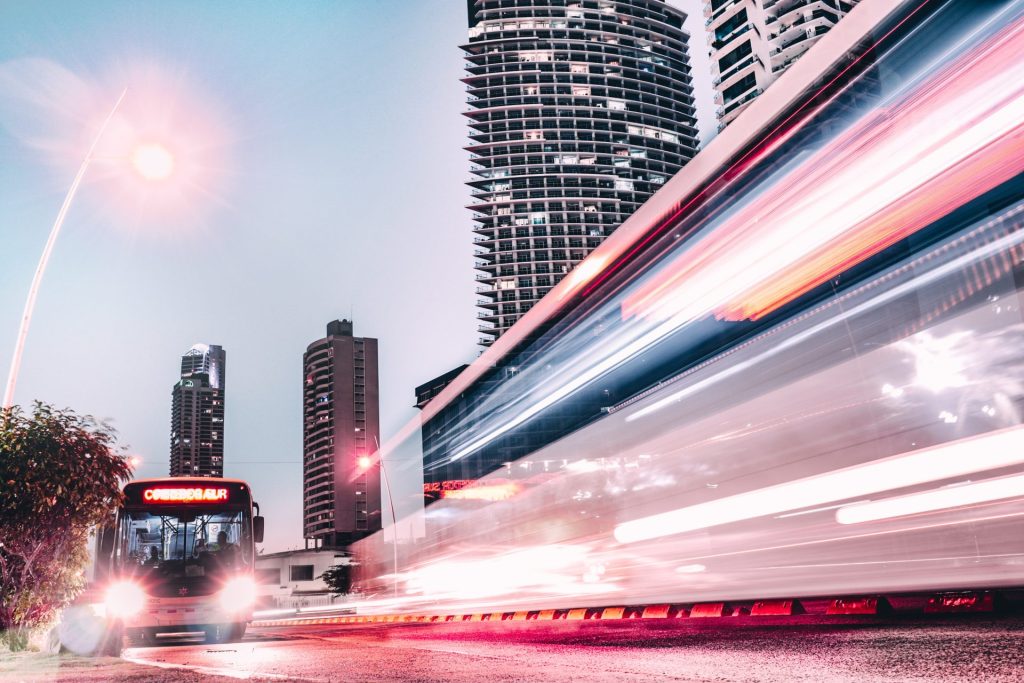
Low Emission Zones: This year’s big bet against urban pollution
As of January 1, 2023, 149 Spanish municipalities must include Low Emission Zones (LEZ) in their urban centers. The new Climate Change and Energy Transition Law, passed in 2021, obliges municipalities with more than 50,000 inhabitants to have these restricted circulation areas for polluting vehicles, something that also applies to those municipalities with more than 20,000 inhabitants that exceed maximum pollution levels. In Spain we have 149 municipalities with more than 50,000 inhabitants, where, according to the National Institute of Statistics, more than 25 million people live, more than half of the inhabitants of the whole country, so that, in 2023, Spain should have at least 149 active and operational ZBEs, like those already existing in Madrid or Barcelona.
But what are Low Emission Zones? According to Article 14 of the new Law on Climate Change and Energy Transition, a Low Emission Zone is defined as “the area delimited by a public administration, in the exercise of its powers, within its territory, of a continuous nature, and in which restrictions on access, circulation and parking of vehicles are applied to improve air quality and mitigate greenhouse gas emissions, according to the classification of vehicles by their level of emissions in accordance with the provisions of the General Vehicle Regulations”. At this point, it is worth mentioning one of the reflections made in another of the entries in this blog, which shows how the “silent killer”, the name given to the polluted air in our cities, kills 520,000 Europeans every year, 29,980 of whom are Spanish. According to statistics from the European Environment Agency, a total of 5,151 premature deaths per year are attributable to road traffic.
Thus, as a tool to improve air quality in cities, the ZBEs are emerging. That said, it will be up to the city council of each locality to establish the restrictions in its urban area, although the conditions of the pioneer cities are expected to be followed. Therefore, it is expected that the most polluting vehicle models (without environmental sticker) will be the most punished by the regulation, being forbidden to enter and circulate in the ZBEs of large cities. Regarding vehicles with label B, in Madrid or Barcelona these vehicles are allowed to enter and circulate, although with certain limitations, since they can only enter if they park in a public parking lot, if their owners are registered in the area or if they are going to a workshop within the ZBE, among others.
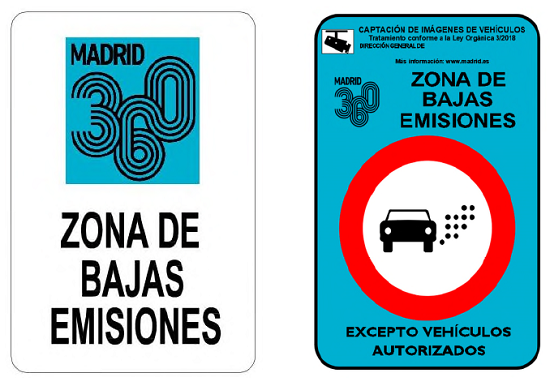
Vehicles with C label will be able to access and circulate in the ZBE, although they will be prohibited from parking, except in public parking lots. Only vehicles with ECO label (hybrid or gas) and 0 Emissions (electric and plug-in hybrids) will be able to circulate freely in the ZBE and be exempt from the prohibitions.
Lights and shadows for electric mobility
The government has set a target of 5 million electric vehicles in Spain by 2030. In the short term, the goal was to reach 250,000 electric vehicles and 100,000 recharging points by 2023. However, these figures still seem far from reality. To give us an idea, the electric vehicle market closed 2022 with 36,452 registered sales, which represents just 3.5% of the cars sold in our country. Although it should also be noted that this sales volume represents a 31.3% increase over the previous year, reflecting the growth in sales of the 100% electric car.
In any case, 2023 looked set to be a complicated year for electric vehicles, as the network of charging points remained limited (16,565 points at the end of the third quarter of 2022) and is very poorly distributed throughout the territory. This scenario posed a vicious circle in which without a network there are no cars and without cars there is not enough pressure to increase the network.
 Location of public access recharging points by Autonomous Region. Source: Own preparation with data from Anfac (third quarter of 2022).
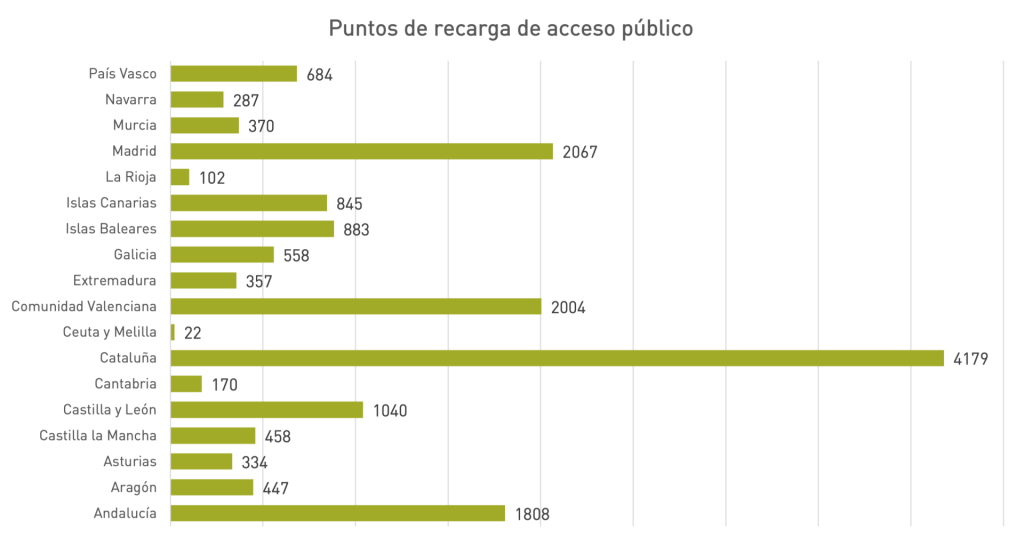 Location of public access recharging points by Autonomous Region. Source: Own preparation with data from Anfac (third quarter of 2022).
Throughout 2023, although the aid of the Moves III Plan will be extended, it is true that this type of vehicles will also have to face the price increase they are experiencing as a result of the increase in the cost of the necessary raw materials (especially for the drift of materials such as cobalt, nickel or lithium, essential for the manufacture of batteries). But it is not all bad news for electric mobility in the new year, since, from January 1, 2023, the new regulations coming into force will serve as a boost for this new form of mobility, with the aim of achieving a zero-emissions scenario by 2035.
Royal Decree Law 29/2021, of December 21, adopting urgent measures for the promotion of electric mobility, self-consumption and the deployment of renewable energies, establishes the obligation to install charging points for electric vehicles in public access spaces, such as supermarkets, hotels, restaurants, shopping centers or private non-residential buildings, such as public garages or workplaces. Those buildings such as the aforementioned, which have more than 20 parking spaces, must have at least one charger installed for every 40 parking spaces. In addition, Law 7/2021 of May 20, the new Climate Change and Energy Transition Law, establishes that service stations must have at least one electric recharging point on their premises (or within a radius of 300 meters), and it will be the number of liters of fuel refueled in 2019 that will delimit the recharging power.
 Recharging an electric car. Source: Pixabay
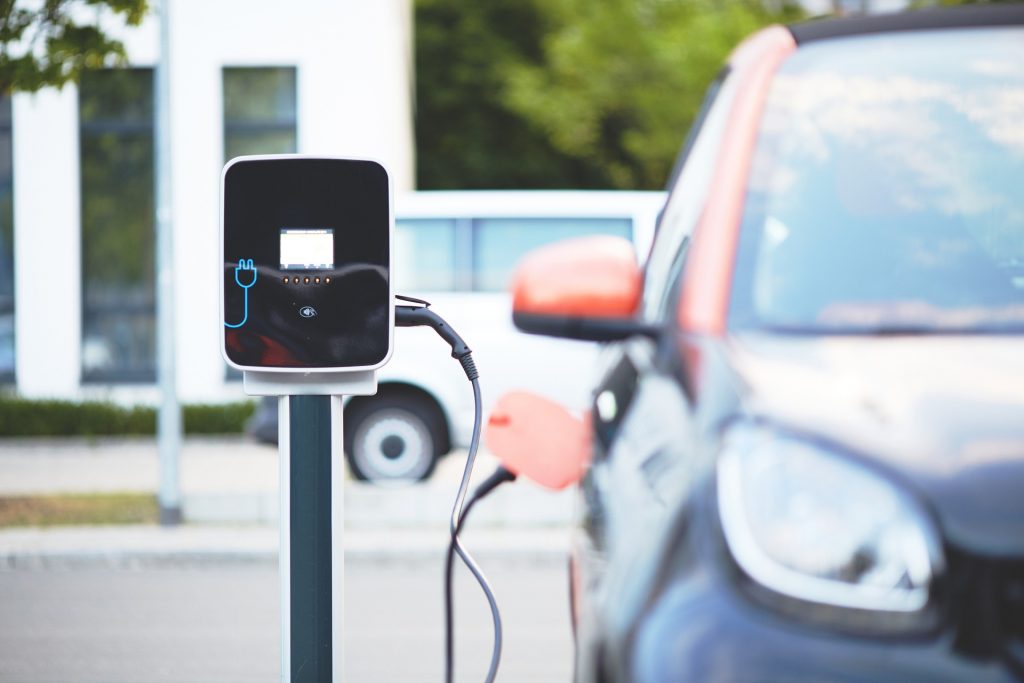 Recharging an electric car. Source: Pixabay
Governmental anti-crisis measures in mobility and transportation.
During 2022, the government implemented various anti-crisis measures that have helped to mitigate the negative impact on citizens of the Ukrainian war, the energy crisis or inflation. With the end of the year some of these measures are coming to an end, others are not, but… how do the new measures affect mobility?
- Fuels: End of the 20 cents/liter subsidy. Generally speaking, this subsidy is coming to an end, however, transport companies will be able to benefit from it until March 31, although from April 1 to June 30, this subsidy will be 10 cents/liter.
- Free RENFE travel passes: Since September 2022, the multi-journey tickets of Cercanías, Media Distancia and Rodalies de Catalunya have been free of charge, and will continue to be so throughout 2023. The “free pass for frequent traveler” is free, four-monthly and single-passenger, allows a maximum of 4 daily trips (exclusively from or to the stations of origin and destination previously chosen), can be purchased two months before its entry into force and, to obtain it, a deposit of 20 euros must be paid (per pass and four-monthly period). In addition, 50% discounts will be maintained throughout the year for multi-journey tickets on Avant and Alta Velocidad.
- Free long-distance buses: Last year, some state-owned routes counted with 50% discounts on multi-journey tickets, this 2023 the bonus increases to 100%. The new measures approved by the Government (in the third package of anti-crisis measures) include free travel on 42 state-owned long-distance bus routes, which includes travel passes, as well as 10, 20 or 30-trip tickets for the lines. As with the RENFE travel passes, a deposit of 20 euros will be required, which will be returned after a minimum of 16 trips.
- Urban and Interurban Public Transport at 50%: The Government has announced for 2023, subsidies of 30% to City Councils and Autonomous Communities that reduce at least 50% of the price of season tickets and multi-journey tickets for urban and interurban public transport. Therefore, the 30% subsidy from the Government is conditioned to the City Councils or the Autonomous Regions providing at least the other 20%.
 Public transportation for much less. Source: MITMA.
Digitalization, the accelerator of Sustainable Mobility
In this 2023, the mobility and transport sectors are facing a new stage marked by change, the result of the need to move towards more sustainable models, based mainly on the decarbonization of urban mobility and the transport system. This new scenario comes in a context in which more and more areas of daily life are succumbing to the digitalization of their processes, and where more and more administrations (municipalities, autonomous communities or ministries) and companies in the sector are advancing in this field.
Thus, the application of digital technologies is emerging as the main pillar around which the transformation of the mobility sector revolves, configuring public transport as an efficient alternative to the private vehicle, accelerating the penetration of “zero-emission mobility” or optimizing the existing transport system. The solutions that digital transformation brings to the mobility sector are infinite and cover a wide range of tools that add different functionalities to the mobility sector.
One of the backbones of the decarbonization strategy for urban mobility consists of displacing the private vehicle from the leading role and placing public transport in it. To this end, there are many measures that can add value to the service, such as updated information in real time, the degree of occupancy, possible incidents, trip planning through mobile applications or websites with new digital payment mechanisms (Bizum, QR codes…), among others.And the reality of public transport is that even today there are still operators that only publish their schedules on the station’s corkboard…
Digitalization will be one of the objectives for the future
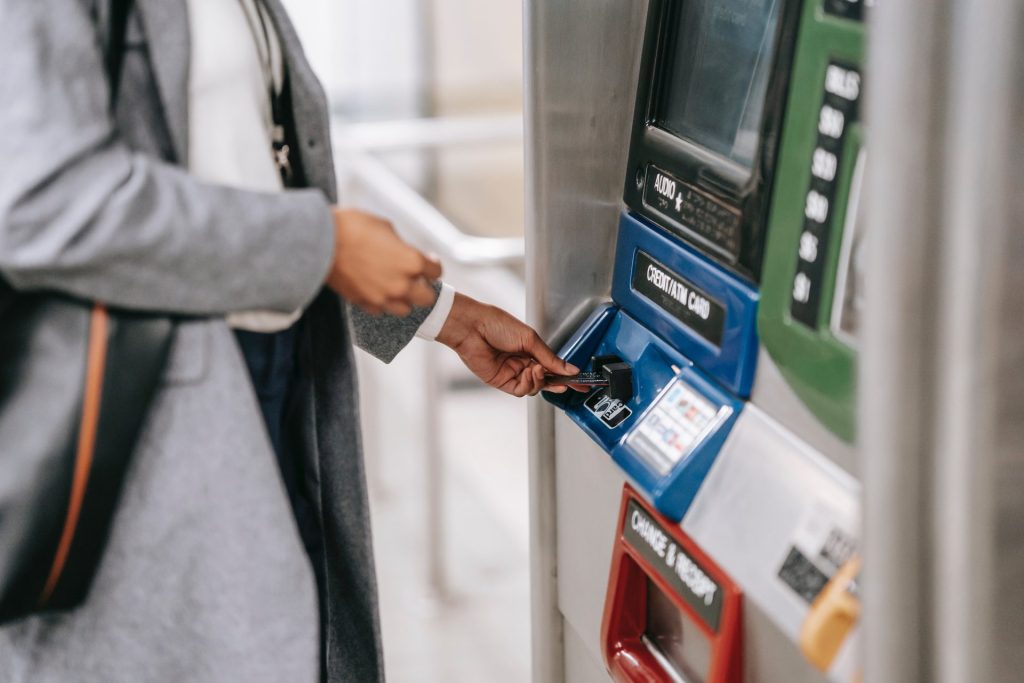 Digitalization will be one of the objectives for the future
However, it must be taken into account that citizen perception is the determining factor for the triumph of sustainable modes over other modes of transport, so the battery of measures outlined above (along with many others) must build an efficient public transport, which is aided by fast, accessible and intuitive digital means, so that citizens have solid arguments in the choice of mode of transport. Digitalization is therefore essential, as it places the citizen at the center of this new mobility and, therefore, increases the chances of success of this new model of sustainability.
And, although we previously talked about digitalization from the citizen’s point of view, from a planning perspective, at Vectio, we are mindful of this important digital transformation and try to take advantage of the opportunities provided by this new scenario, adopting digital tools and processes from the earliest stages of our projects. As an example, already in the planning phases we use technologies such as Big Data to extract accurate information from traffic or daily mobility (among many other sources of information), which allows us to be more accurate in the development of field work or cross-reference different sources of information, obtaining arguments that would be impossible to obtain by other conventional means.
However, we must not forget that any change entails an economic effort, and that these challenges come at a time of global crisis and climate urgency. To support these reforms, the European Next Generation EU funds were created, which in Spain are channeled by the Ministry of Transport, Mobility and Urban Agenda (MITMA), through grants, subsidies and public tenders. Throughout 2023, new Strategic Projects for Economic Recovery and Transformation (PERTE) was scheduled to be launched. The latest of these projects, focused on industrial decarbonization, was approved at the Council of Ministers on December 27, 2022. It is expected that, in addition to the 12 existing projects (which are dedicated to areas of electric and connected vehicle development, renewable energies, circular economy, etc.), projects will continue to be added as this year progresses.
 NextGenerationEU funds. Source: MITMA.
 NextGenerationEU funds. Source: MITMA.
Micromobility in large cities
First of all, the concept of “micro-mobility” should be developed, as it is a word that is increasingly used in society and in the media.The term “micro” reflects the use of small, environmentally friendly vehicles that are also used to cover short distances, usually the first or last kilometer of a journey.
The most widespread micromobility solutions today include light vehicles such as scooters, bicycles and other small (usually electric) means of transport. However, based on the needs of this type of mobility and some of the innovations presented during 2022, we can distinguish some trends in the area of micromobility that will be trending in 2023.
- Mobility Hubs: These Mobility Centers provide citizens with an accessible and attractive alternative to private vehicles in urban areas, bringing together different modes of urban transport at the same point. This promotion of intermodality integrates public transport, shared mobility points (bicycles or scooters), access to cycling routes, electric vehicle recharging, etc… Proper planning and integration of these centers in urban areas of large cities reduces traffic congestion and ensures that all travelers have access to their transport option.
- Electric bicycles: More and more cities are successfully integrating pedal-assisted electric bicycles into their fleets. E-bikes are perfect for the usual short commute, allowing the commuter to move around the city without much effort and without relying on a car.
- MaaS (“Mobility as a Service”): “Mobility as a Service” emerges as a technological innovation that consists of integrating into a single platform all public and private modes of transportation available in a city, from which the user can plan, book and pay for their transportation (within the same application).
 Micromobility solutions take over cities
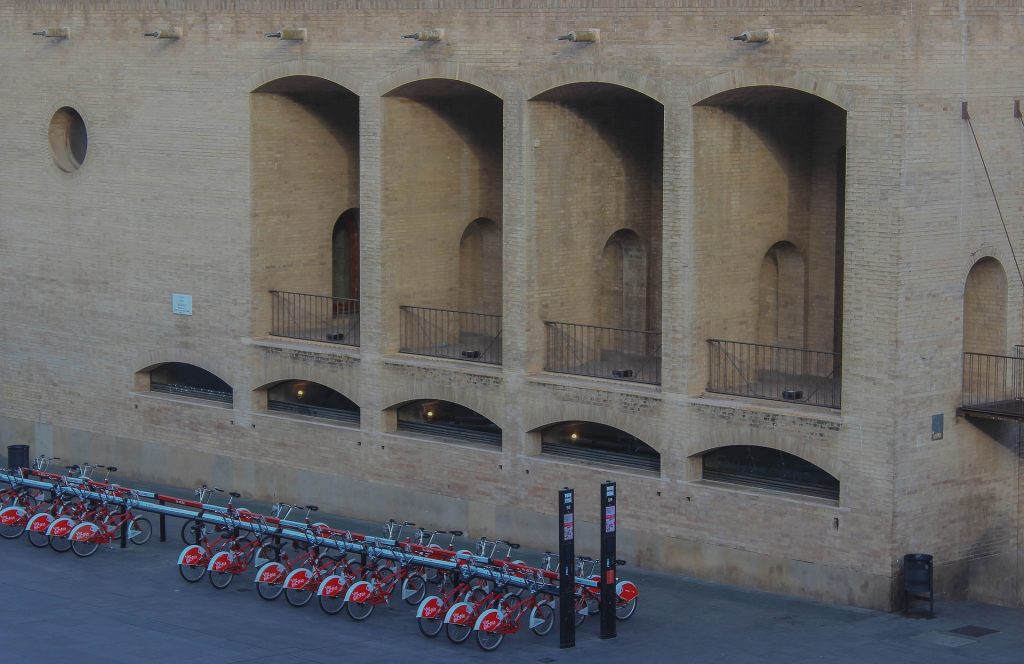 Micromobility solutions take over cities
These innovations only highlight the fact that micromobility is becoming one of the mobility solutions for cities that combines time savings for commuters with care for the environment. It is enough to take a look at the street and observe the large number of bicycles and electric scooters circulating on urban roads.
Carlos Gonzalez | Civil engineer
Sources:
Law 7/2021, of May 20, on climate change and energy transition.
Royal Decree 266/2021, of April 13, which approves the direct granting of aid to the autonomous communities and the cities of Ceuta and Melilla for the implementation of incentive programs linked to electric mobility (MOVES III) within the framework of the European Recovery, Transformation and Resilience Plan.
Royal Decree-Law 29/2021, of December 21, adopting urgent measures in the energy field to promote electric mobility, self-consumption and the deployment of renewable energies.
Recovery, Transformation and Resilience Plan (PRTR). Consulted through the website of the Ministry of Transport, Mobility and Urban Agenda (MITMA).
Strategic Projects for Economic Recovery and Transformation (PERTE). Consulted through the Recovery, Transformation and Resilience Plan website.
National Integrated Energy and Climate Plan (PNIEC) 2021-2030. Consulted through the website of the Ministry of Transport, Mobility and Urban Agenda (MITMA).
Strategic Projects for Economic Recovery and Transformation (PERTE). Consulted through the Recovery, Transformation and Resilience Plan website.
National Integrated Energy and Climate Plan (PNIEC) 2021-2030. Consulted through the website of the Ministry of Transport, Mobility and Urban Agenda (MITMA).
Digital Spain Agenda. Consulted through the website of the Ministry of Transport, Mobility and Urban Agenda (MITMA).
Next Generation EU | Recovery Funds for Europe. Portal of the Ministry of Finance and Public Function.
Demographic and population database of the National Statistics Institute (INE).
Electromobility Barometer. Spanish Association of Automobile and Truck Manufacturers (Anfac).
