

Traffic engineering requires tools that enable the quality of traffic flow to be quantified objectively, critical points to be identified, and the future behaviour of infrastructure to be predicted in response to changes in vehicle demand. In this context, Levels of Service (Level of Service or LOS) have established themselves as one of the most influential international tools for analysing the capacity and performance of road infrastructure.
Levels of Service enable the operational quality of road infrastructure to be measured using standardised and comparable criteria. Thanks to them, it is possible to translate complex traffic variables into a simple scale ranging from the letter A to F. What began as a methodology developed in the United States has ultimately become an essential benchmark for road planning and design worldwide, including in Spain.
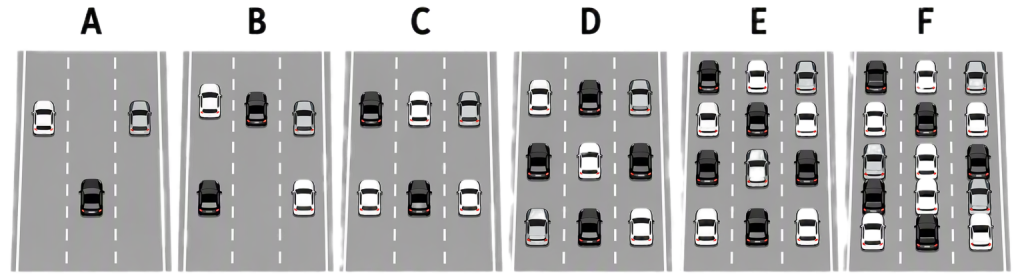
To discuss levels of service, we must first recognise that their history began with the publication of the first Highway Capacity Manual (HCM) by the Bureau of Public Roads and the Transportation Research Board (TRB) in 1950. Its initial purpose was to provide standardised methods for estimating the capacity of different types of road infrastructure, at a time when growing traffic volumes were beginning to demand more rigorous technical tools for road planning and design.
However, it was not until the 1965 edition that the concept of Level of Service (LOS) was introduced into the HCM. The TRB recognised that it was not enough simply to measure how many vehicles a road could accommodate; it was also necessary to assess the quality of traffic flow as perceived by users, using parameters that represent the operational conditions of an infrastructure, such as speed, density, intensity, delays or queues, amongst others. This approach transformed traffic engineering, becoming the methodological basis still used today by the majority of traffic and capacity studies worldwide.
Although levels of service were originally developed to analyse the performance of existing roads, they now play a much broader role in transport planning. Their main value lies in the fact that they enable scenarios to be compared and allow us to quantify how an infrastructure will evolve in response to changes in demand.

In traffic studies, it is common to analyse different time-based scenarios: the current situation, a future scenario with no intervention, and a future scenario involving the implementation of a new development. Comparing the levels of service obtained in each case makes it possible to objectively identify the impact that a specific intervention will have on the road network and to determine whether corrective measures or capacity-expansion measures are necessary.
For example, when assessing a new shopping centre, a logistics hub or an urban development, service levels make it possible to check whether existing junctions or interchanges and the main access routes will continue to function adequately by the project’s target year. If the infrastructure maintains acceptable levels, it can be concluded that it has sufficient capacity. If, on the other hand, significant deterioration occurs, the study must propose specific improvements.
In Spain, the regulations governing the preparation of traffic studies expressly incorporate the concept of level of service as one of the fundamental criteria for the design and assessment of roads.
The clearest references are found in Standard 3.1-IC on Alignment, which explicitly incorporates the methodology developed in the HCM by stipulating that “the level of service shall be obtained in accordance with the methodology developed in the TRB Capacity Manual”.
This reference is not merely academic, as the standard uses levels of service as a design criterion that determines such key aspects as the cross-section, the number of lanes or the need to provide for future capacity expansions, amongst other factors.
Furthermore, in Service Note 5/2014, the reference document for the preparation of traffic studies on the National Road Network (RCE), a specific chapter is devoted to the analysis of levels of service, setting out the procedures for assessing the performance of motorways, dual carriageways, multi-lane roads, convergence and divergence sections, junctions and intersections. Thus, the methodology set out in Service Note 5/2014 proposes a detailed study of how an infrastructure will function once it is put into service, through the analysis of capacity, demand forecasting, modelling and the assessment of future conditions… all of which utilises indicators directly derived from the HCM philosophy.

For its part, the General Road Regulations (approved in October 2025) stipulate that any intervention that may affect the functionality of the road network – particularly new connections, access points or developments that generate traffic – must be analysed for its impact on the capacity and operation of the road. Although the regulations do not expressly specify the use of the HCM methodology, it is common practice to use levels of service as indicators to assess the extent to which the project under study will be affected.
In addition to these regulations, there are numerous traffic assessment guides, design manuals and planning tools at local, regional or national level which also adopt the HCM methodology – and, specifically, levels of service – as a tool for the planning, design or management of infrastructure and new urban developments.
As such, service levels remain one of the most widely used indicators for assessing the performance of road networks and supporting decision-making.
Their success lies in a fundamental characteristic: they are capable of transforming complex calculations of capacity, travel times or traffic densities into a simple and easily understandable scale, enabling engineers, public authorities, developers and the public to speak a common language when assessing the performance of an infrastructure. It is precisely this combination of technical rigour, ease of interpretation and the ability to compare scenarios that explains why service levels remain one of the most widely used and useful tools today for assessing the impact of traffic and for planning traffic and transport.
All the signs suggest that their importance will continue to grow in the future. The development of more advanced simulation models, the availability of big data on mobility, and the incorporation of new modes of transport will enable a more precise analysis of the behaviour of road networks. However, regardless of how analytical tools evolve, service levels will continue to play an essential role: providing a common language that allows the performance of transport infrastructure to be assessed, compared and communicated in an objective and comprehensible manner.
Thank you for reading.
Carlos González | Civil Engineer
About Vectio
At Vectio we focus on the effective planning of sustainable mobility; we are experts in this field. Throughout our nineteen years in business, we have always maintained a commitment to innovation, investing in the technological solutions most sought after by our clients. We firmly believe that, having successfully completed more than 1,500 projects, what sets us apart from any other company in the sector is our use of the very best technology for traffic and mobility data collection and analysis.
