

The most populous city in the southern hemisphere and the economic engine of Brazil is immersed in an ambitious project to adapt its urban mobility. Following in the footsteps of other Latin American metropolises, Sao Paulo is seeking to alleviate its serious congestion problems by implementing collective and sustainable means of transport. One of the São Paulo municipality’s bets is its urban tramway project known as VLT (Veículo Leve sobre Trilhos), which is scheduled to come into operation in 2027. With an estimated budget of 4 billion reais (about 600 million euros), the VLT will consist of two lines that will extend over a total of 12 kilometers and will have 27 stops. Aimed at relieving traffic in the city center, the system will start with 9 trains with a maximum capacity of 447 passengers and is estimated to carry up to 134,000 people per day. The approach is part of a strategy to reclaim downtown São Paulo by improving mobility, safety and livability.
But in a city of more than 12 million inhabitants, the proposals must cover more ambitious spaces, so the authorities are working in parallel on another series of measures to improve urban mobility. Its already extensive BRT network, whose construction began in 1997, already includes several networks such as the Expresso Tiradentes, which has 22 kilometers and 10 stations on its two operational lines. Another BRT network, the ABC, will soon come into operation. Its estimated start-up date was set for 2023, but various technical and financial problems have delayed its implementation. The BRT-ABC will consist of 20 stops and 3 terminals linking 18 kilometers thanks to 82 23-meter articulated electric buses.
Presentation of the BRT-ABC project. www.brtabac.com.br
On the other hand, the São Paulo railway network (Red de Transporte Metropolitano sobre Riels) is the most extensive in all of Latin America, with 377 kilometers distributed among the 13 current lines. Its network is made up of a total of 187 stations that transport more than 8 million passengers every day, and is managed by four companies, two private and two public. One of them, Companhia do Metropolitano de Sao Paulo, can boast of being one of the most modern on the continent, having already implemented in 2010 technologies such as the CBTC signaling system, autonomous driverless trains or platform doors. Despite being of relatively recent implementation (1974) for the size of the city’s population, the São Paulo Metro was already considered in 2015 the best in the world by Business Insider. The current 6 lines, of which two are under expansion, will be 8 in 2026 if the schedule that foresees the opening of lines 6 and 17 is met.
In addition, the bidding process for a project whose first project dates back several decades, the submarine tunnel that will connect the city of Santos with the beach resort of Guarujá, was recently presented. Just 70 kilometers from the capital of São Paulo, the port of Santos is one of the most important in Latin America and the economy of the city of the same name is one of the strongest in Brazil. The infrastructure will consist of a tunnel 21 meters above the seabed that will be developed in concrete sections on the outside and sunk under the channel. It will have a total length of 1.5 kilometers, more than half of which will be under the sea, and will consist of 3 lanes in each direction, one for the VLT, plus pedestrian and bicycle access. As announced by the authorities (despite the polarization of Brazilian politics, the Lula government and the conservative government of the State of Sao Paulo go hand in hand for the project), the project will be auctioned on August 1, 2025 at the São Paulo Stock Exchange. Major engineering firms from all over the world have submitted bids for a project budgeted at some 6 billion reais, more than 900 million euros, and which will improve the mobility of the 78,000 people who cross the bay every day.
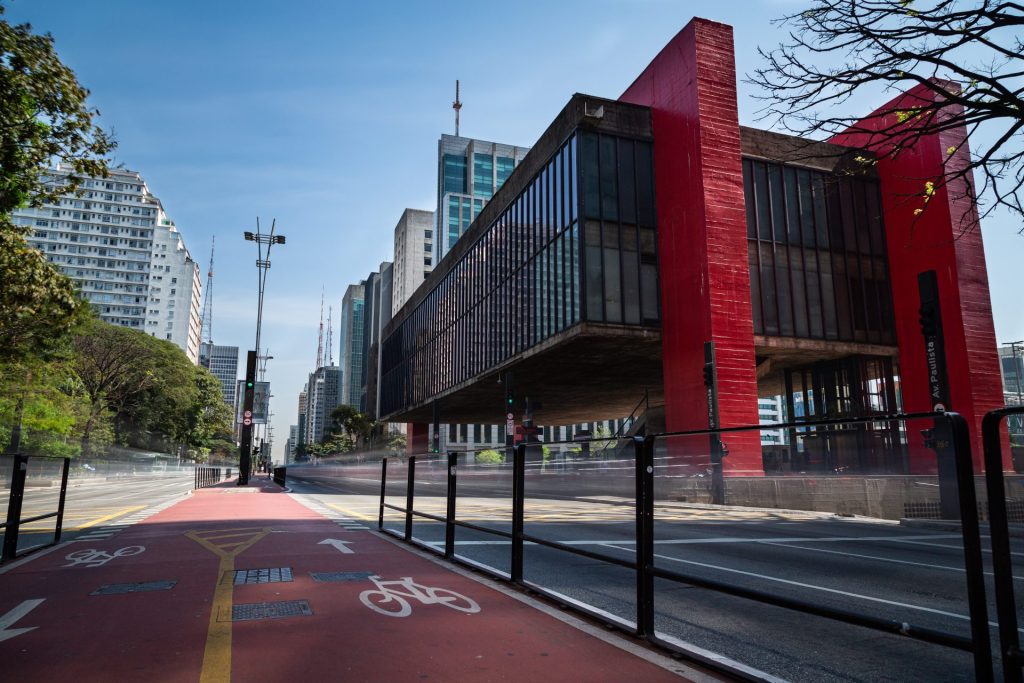 Bike lanes in front of the Sao Paulo Art Museum Assis Chateaubriand, Paulista Avenue, Sao Paulo.
The other Brazilian metropolis, Rio de Janeiro, can boast of a VLT already in operation and its commitment to electric buses, but it still suffers from serious traffic problems and mobility in the capital is far from being the best. During 2024, only 672 million passengers used its network, practically half the number of a decade earlier. This has been due to a concatenation of factors such as changes in habits due to the increase in internet shopping and teleworking, the aftermath of the COVID-19 crisis left both in transport companies and in the 25% drop in travelers, as well as the irruption of services such as Uber or illegal minibuses. Throughout the country, passenger bus operators live between an endemic financial crisis that public subsidies are partially saving and the precariousness of a service whose degree of satisfaction has declined in recent decades. Free service is an option, especially in small municipalities where the cost of the service can represent 1% of municipal income, but it is unsustainable in cities like Belo Horizonte, with 2.5 million inhabitants, where it would represent 10% of all income generated by the municipality.
But if there is a Brazilian city whose mobility has been a worldwide example for decades, it is undoubtedly the capital of the province of Paraná, Curitiba. Known as Brazil’s green city, it is also recognized for its excellent public transportation, consisting of a system of buses that operate with bus-only lanes.About 85 percent of the population uses this service.It was in 1985 that Curitiba designed its Master Plan based on three key aspects: road system, land use and public transportation. Curitiba’s Integrated Transport Network is a pioneering BRT system that has served as an example for cities such as Bogota, Lima, Jakarta and Las Vegas. The RITC currently has 157 bi-articulated and 29 mono-articulated vehicles propelled by biofuels that provide service in a network with 21 elevated stations, adapted and allowing the interconnection of lines.
The Development Bank of Latin America and the Caribbean (CAF) recently granted a US$150 million loan for the municipality of Fortaleza to improve its mobility. The municipality of this city, the fourth most populated in Brazil, will invest a large part of this sum in the construction of a new tunnel and a viaduct to improve traffic and, in particular, public transportation, as well as 20 new kilometers of bicycle lanes.
Brazil is one of 35 countries worldwide where Vectio has developed projects since 2007, some of them in the state of Sao Paulo.
Links:
https://www.intertraffic.com/news/espanol/el-reto-de-movilidad-urbana-brazil