

As mobility management becomes more and more sophisticated, we also have better tools that allow for a more accurate approach. In this case, technology is a fundamental support to guarantee the profitability and sustainability of the proposed mobility models.
In this sense, for traffic and transport engineering, different types of simulations are key. Micro and macro simulations are some of the analysis tools that allow us to know, understand and make decisions regarding highly complex systems.
This is the case of mobility simulation, needed to understand the processes that occur in the present as well as to predict behaviour and situations, enabling adequate traffic management in the future as an efficient organization of the mobility is key to the life of cities and communication routes among a country.
When running a simulation, a model is necessary to represent the study area and observe the functioning of the place with the aim of solving all its deficiencies. The simulation team will modify this base model to generate different mobility models and represent them graphically.
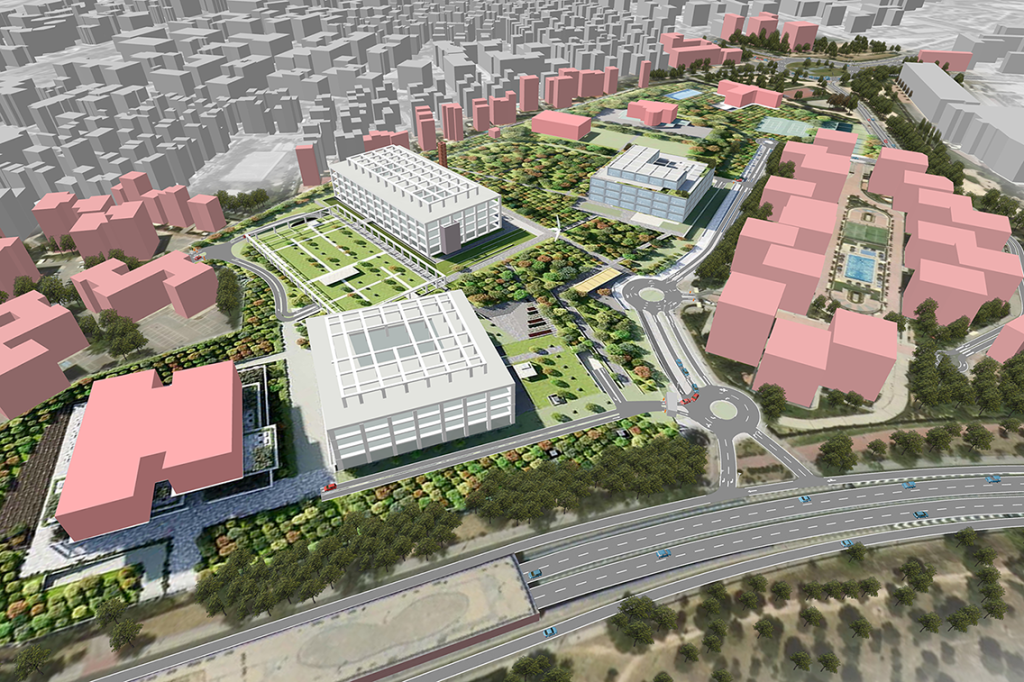
In the mobility models, these variants are executed as different scenarios, for each of which a simulation is developed. The results of this simulation will be used to answer the unknowns of each scenario regarding the traffic and transport represented.
As a representation of a complex system, a traffic model is composed of several parameters whose objective is to simulate the behaviour of vehicles, whether private or public, and/or pedestrians. The results of this simulation depend on the one hand, on the structure of the model itself (road system, traffic-light junctions, etc. ….) and, on the other hand, on the behaviour of these vehicles and pedestrians.
When our intention is to explore different control options, constructive solutions at road level or situations in the system, we work so that the simulation results are due to these structural changes. To achieve this, it is essential that the behaviour of the vehicles is coherent and adjusted to reality.
What is the key for a model to be useful? That it generates results that are close to reality, i.e. that it allows us to diagnose the present and make correct forecasts for the future in our studies. To achieve this, the behavioural parameters must take the appropriate value so that the simulation results are realistic.

The adjustment of the parameters so that the model represents the system correctly is the calibration and validation process that specialists carry out in each study. Usually, these parameters are calibrated manually, using the error and approximation method. Generally, when calibrating traffic models, actual measurements of speeds, flows (vehicles/time) and densities (vehicles/track length) are available, and it will be up to the simulation technicians themselves to optimise the combination of these measurements to achieve maximum efficiency.
In short, it will be the quality of the input data, the reliability of the model and the experience of the technician himself that will allow us to speak of success in a mobility simulation.
The development of information technologies offers us access to new sources of traffic and transport data that we can incorporate into our models, such as, for example, data collection through artificial vision or the use of drones to obtain information from the sky. A world of new opportunities that is enriched day by day and allows us to offer clients more accurate simulations that provide greater value to their decision-making.
Source:
Aimsum
Simulation Application in Traffic Control, a Proposal for Ciudad del Este – Lorena Franco
