

Attending a major sporting or musical event is always a great experience, although for many fans the real challenge is simply getting to and from the venue smoothly. In 2014, the study Mobility within sporting events conducted by Fesvial, Pelayo and Continental already reflected a worrying statistic: 78% of attendees negatively evaluated the organization and accessibility of travel to sporting events. If anyone can attest to the results of this survey, it is the thousands of Real Madrid and Liverpool fans who suffered chaos and assaults by organized gangs in the face of the passivity of the security forces at the Champions League final in Paris in 2022. On that occasion the media, especially the English media, did not hesitate to charge the UEFA organization as the main responsible for a serious security and coordination failure.
However, what is often hidden from the media spotlight is an equally critical problem: managing the mobility of thousands of people attending a massive event, such as a major music festival or a sporting event. At the last Olympic Games in Paris, the French capital also had to face a major mobility challenge. Our colleague Carlos Gonzalez prepared an extensive report on how the Organizing Committee was dealing with this event in terms of mobility. Several of the lines of action are already a standard in any urban sustainable mobility plan: commitment to cycling, replacement of polluting vehicles with electric vehicles and, above all, improvement of public transport services.
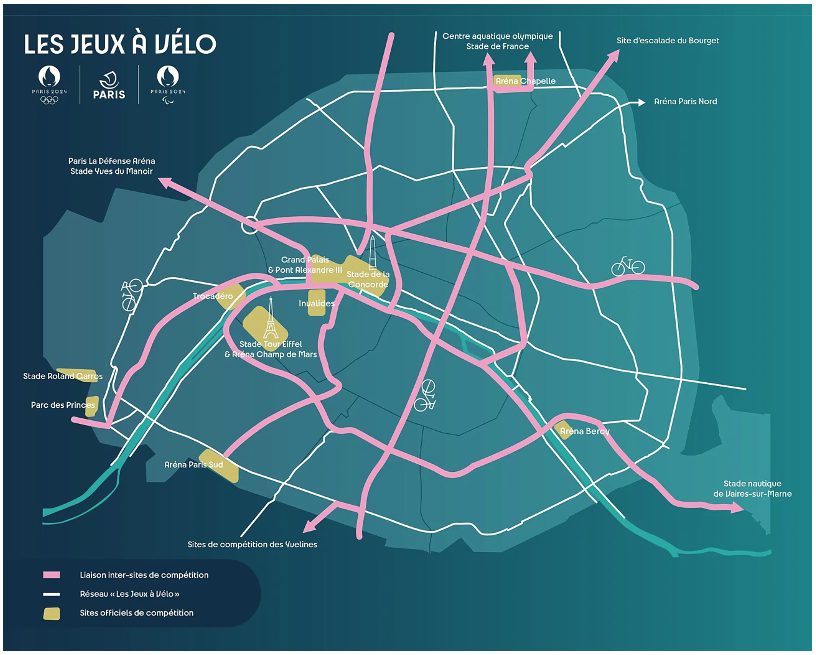 In Paris 2024, the bicycle was chosen as the priority means of transport.
Location, accessibility and mobility have always been an important factor when it comes to locating a venue for major events, although in ancient times this mainly boiled down to allowing spectators to reach spaces such as Roman amphitheaters or medieval cathedrals on foot. Since sport became a mass entertainment at the beginning of the 20th century, the needs have increased exponentially. As early as the 1930s, soccer matches at Hampden Park stadium in Glasgow, Scotland, often drew almost 150,000 people. Access to the area of the Scottish stadium for this huge number of spectators was provided by the public transport of the time (streetcars, buses and the fourth oldest subway network in the world), and the low population density in the south of Glasgow also helped to alleviate the crowds. In other countries, all the magnitudes surrounding sporting events were very different. When in 1924 Real Madrid C.F. built its first brand new stadium in Chamartín de la Rosa, inspired by British aesthetics and with a capacity for 15,000 spectators, the only concessions to the mobility of the attendees were a streetcar stop and the nearby open fields where the first private cars in the capital could park.
 Attendees of an Atletico de Madrid match queue outside the Metropolitano Stadium in the direction of the Metro station of the same name.
 Attendees of an Atletico de Madrid match queue outside the Metropolitano Stadium in the direction of the Metro station of the same name.
After the Second World War, and due to various tragedies caused by both overcrowding and public order problems, stadium capacity was progressively reduced. By the end of the century, practically all the seats in any stadium worldwide were seated, with the consequent improvement in comfort, safety and capacity control. Today, there are hardly any stadiums with more than 90,000 seats, but the needs (and demands) of those attending a show whose price has also risen well above the cost of living, are also greater. Nowadays, a sports venue is not only a space for sport, but it is also very common to attend concerts or any other mass event that requires a series of conditions. Just this week, one of the most powerful sports clubs in Europe, Manchester United, announced that it will build a new mega stadium for 100,000 people and that this project will create 92,000 jobs, generate a new residential area with 17,000 homes and generate 9,000 million euros for the British economy. The economic weight of the events and mass sports industry is growing in Western Europe, and the data testify to this.
 Atletico Madrid fans crowd the Metropolitano metro station after a Liga match.
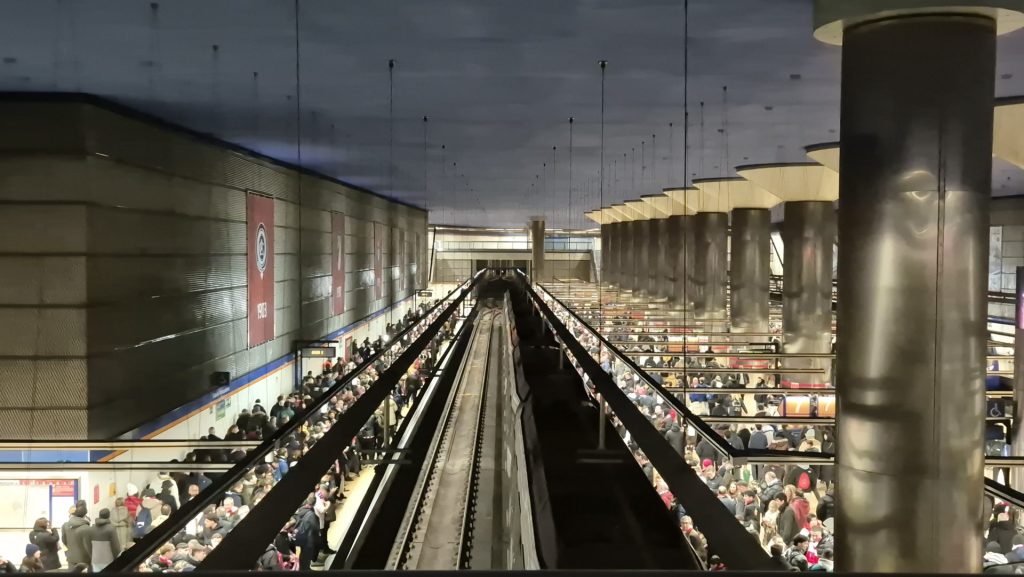 Atletico Madrid fans crowd the Metropolitano metro station after a Liga match.
The impact of the Champions League final played at the Metropolitano Stadium in 2019 for the Madrid economy was more than 62 million euros (almost €1,000 per match attendee). But if sport attracts crowds, what about music stars? The Eras Tour alone, which took Taylor Swift to 19 countries between 2023 and 2024 with 151 concerts, is estimated to have had an impact on the economy of these cities of more than 8.5 billion dollars. Her two concerts in Madrid, on May 23 and 24, 2024, generated some 26 million dollars directly, and it was even estimated to have an impact of close to 150 million euros.
Regardless of where in the world it is held, whenever a large-scale show is planned, there are several plans to consider:
– Pedestrian Flow Study and design of the Access and Evacuation Plan.
– Massive parking management, both dissuasive and proximity parking.
– Traffic Plan, parking restrictions, traffic cuts and detours.
– Public Transportation Plan, including reinforcements and scenario simulation.
– Coordination with Security, Emergency and Command Post plans.
In addition, another determining factor when it comes to properly managing all mobility needs for both spectators and residents is the nature of the location of the venue where the match or concert will be held. For decades, the natural process has been to move large stadiums to the outskirts of cities, as is the case with the Allianz Arena in Munich, the San Siro in Milan or the Olympic Stadium in London. But stadiums are also being built or renovated in city centers, such as the new Everton Football Club ground in the docks of Merseyside, the new San Mamés or the only stadium that Taylor Swift has ever visited in Spain: the reopened Santiago Bernabéu in Madrid. In the latter case, mobility management is complicated on several levels, as the needs of the event (69 production trailers that had to be parked in the street or the thousands of fans who queued for days before the opening of the doors) are joined by those of the neighbors who end up suffering from street closures and saturation of public transport.
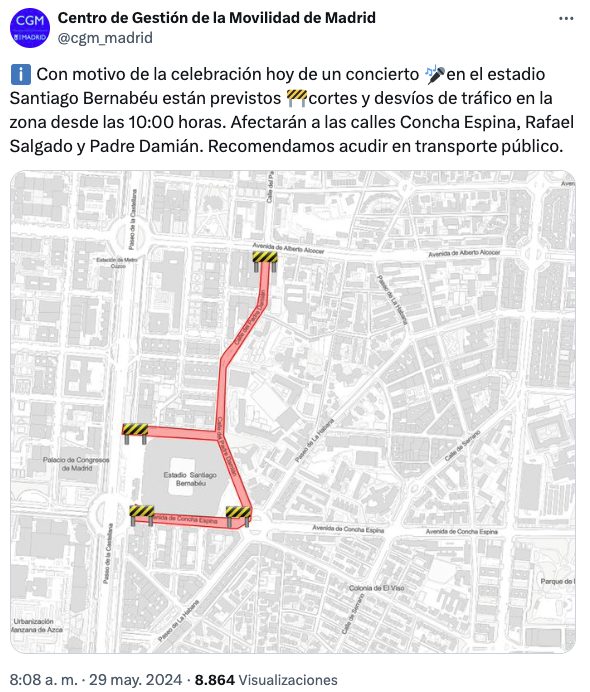
Publication in X of the Madrid Mobility Management Center on the morning of Taylor Swift’s first concert at the Santiago Bernabeu.
Within the Mobility Plan implemented to cover the mobility of the more than 150,000 people who would come in less than 48 hours to attend the two concerts of the singer from Pennsylvania, the following measures were contemplated:
– Line 10 of Metro de Madrid extended its services by 200%.
– Reinforcement of 7 urban bus lines and 4 commuter train lines.
– Total or partial cuts in 7 streets and incidents in another 8 streets.
But if there is one factor related to mobility that Taylor Swift’s fans (known as Swiftys) have influenced the most during her European tour, it has been the increase in rail transport. During the months of the Eras Tour, some routes have seen an increase of more than 850% in their occupancy due to the movements of fans following their diva, as happened on the occasion of her concert in Edinburgh. In the Spanish case, the Seville-Madrid route saw 254% more tickets sold, while the Madrid-Barcelona route grew by 152% compared to a normal day.
 Taylor Swift’s double date in Madrid caused the average price of overnight stays in Madrid hotels to rise by up to 23%.
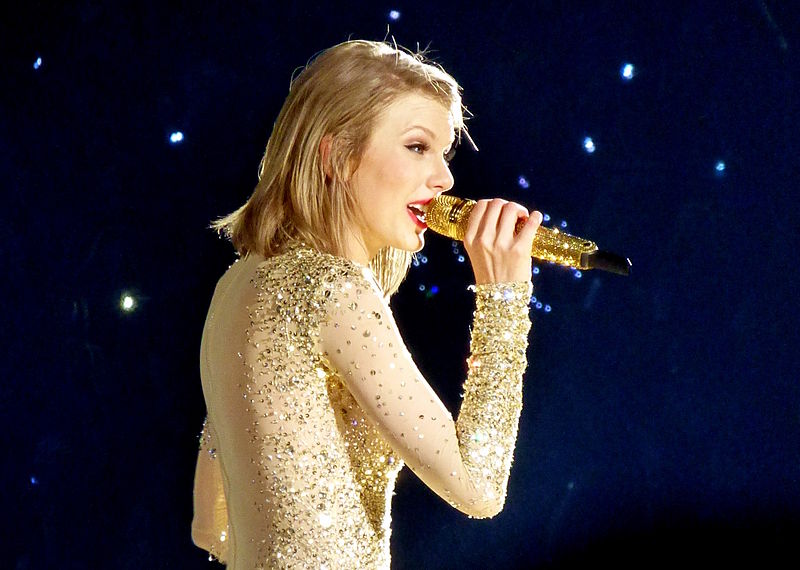 Taylor Swift’s double date in Madrid caused the average price of overnight stays in Madrid hotels to rise by up to 23%.
At Vectio we are experts in mobility planning, traffic studies and pedestrian capacity, three fundamental aspects for a successful Mobility Plan for an event of these characteristics. Thanks to our 18 years of experience in Traffic and Transportation Engineering, and the use of tools specifically designed for pedestrian management, such as Legion, we can guarantee the perfect management of mobility needs in mass events.
Links:
https://vectio.es/blog/jjoo-paris-2024-los-retos-de-una-movilidad-olimpica-y-sostenible/
https://www.bankinter.com/blog/finanzas-personales/taylor-swift-impacto-economico-swifteconomics