

The latest issue of the *Ería* Geography Journal features a new article by Vectio, detailing a mobility project we have carried out, covering every stage of the process and its final implementation. In this instance, we draw on our work in developing a Sustainable Urban Mobility Plan for Cabrales Town Council, in the Picos de Europa region of Asturias. This summary adapts the main conclusions of the article to a perspective aligned with Vectio’s experience in mobility planning, traffic management and territorial sustainability.
Cabrales: managing mobility to preserve the territory
The Cabrales Sustainable Urban Mobility Plan (SUMP) is an example of how mobility challenges in rural and mountainous areas require specific solutions, distinct from conventional urban models. The municipality, with a population of just 1,908 and a declining demographic trend, experiences significant seasonal pressure arising from tourism linked to the Picos de Europa, the Cares Route and the Bulnes funicular.
From Vectio’s perspective, the main challenge is not merely to improve travel, but to strike a balance between accessibility, economic activity, quality of life and environmental conservation. The assessment highlights a high dependence on private cars, driven by the scattered nature of the population and a limited provision of public transport, particularly outside the peak season.
 The municipality of Cabrales is a top-class tourist destination, with attractions such as the Picu Urriellu (or Naranjo de Bulnes).
Mobility data show very significant concentrations of traffic and parking at certain points, particularly in Poncebos, the gateway to the Bulnes funicular and the Cares Route. During summer peak hours, more than 60 per cent of visitors entering the municipality head for this area, causing problems with congestion, unauthorised parking and the occupation of road space.
Vectio’s experience shows that this type of environment requires comprehensive, data-driven management. The combination of capacity monitoring, analysis of tourist flows, smart car park management, real-time information and enhanced public transport services makes it possible to manage demand before congestion arises.
 The village of Bulnes, in Cabrales, is known for being difficult to reach, as it can only be accessed by funicular or on foot.
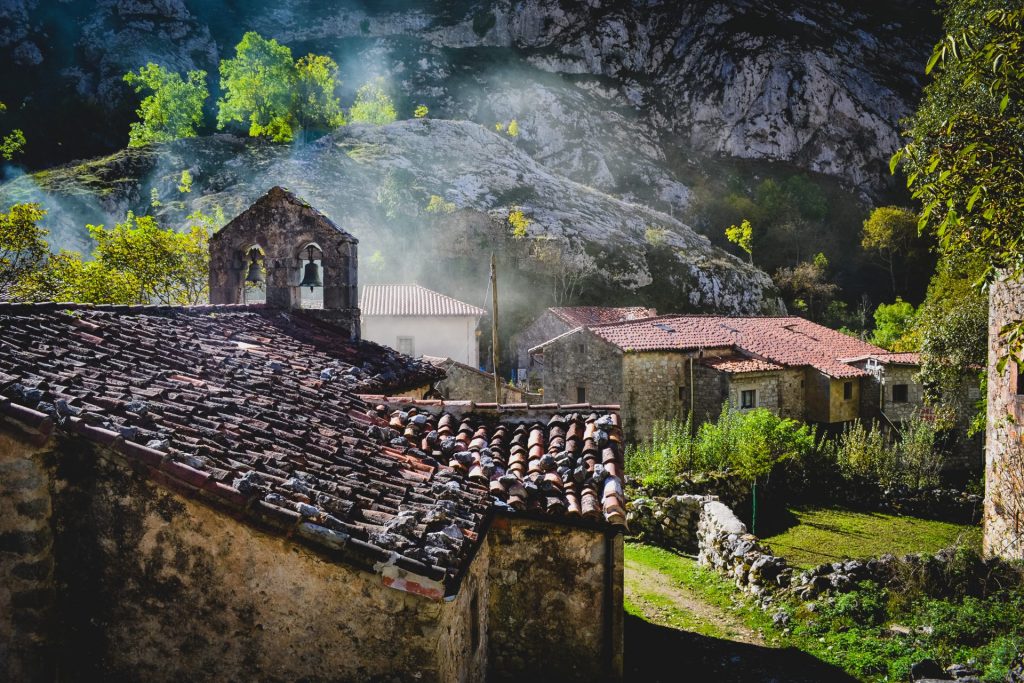 The village of Bulnes, in Cabrales, is known for being difficult to reach, as it can only be accessed by funicular or on foot.
The case of Cabrales confirms that sustainable mobility in rural areas does not involve restricting travel, but rather offering efficient alternatives tailored to the local area. Integrated planning of access routes, park-and-ride facilities, pedestrian mobility and seasonal public transport is a key tool for reconciling tourism development with the protection of one of the most valuable natural areas in northern Spain.
About Vectio
At Vectio, we focus on the effective planning of sustainable mobility; we are experts in this field. Throughout our nineteen years in business, we have consistently maintained a commitment to innovation, embracing the technological solutions most sought after by our clients. We firmly believe that, having successfully completed more than 1,500 projects, what sets us apart from any other company in the sector is our use of the best technology for traffic and mobility data collection and analysis.