

The bicycle is that mythological animal that every self-respecting mobility technician would like to have in their city, but which never quite makes it. It seems that no matter how much is done, it will never cease to be an amusing anecdote in the statistics, and there will always be those who say that Spain is not the Netherlands, that it is too hot here and that there are many slopes.
And they are not wrong, in the Netherlands there are no slopes and it is not hot, but it does rain more than half the days of the year, the humidity is over 70% and the wind speed does not usually drop below 10 km/h, with average speeds in winter of 20 km/h. To put you in the picture, here’s what a day is like with a bit of wind.
And then comes the second excuse, that cycling is part of the culture of the country, and it is natural to use it. And, thinking about the current situation, there is some reason for this. Bicycles are so closely linked to the country that, for example, when you arrive as an expatriate, getting a bicycle is one of the first things you have to do. However, you don’t have to go back many years to see that this has not always been the case.
About half a century ago, Dutch cities did not differ much from those in the rest of Europe, following an unstoppable trend of developing car infrastructure. The pedestrian was relegated to the background and almost all public space was devoted to the service of the private car.
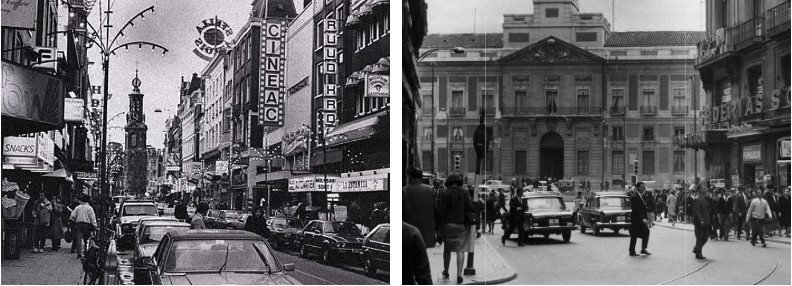
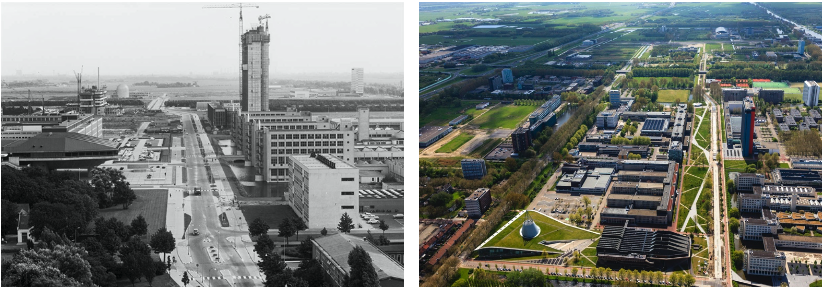
However, the 1970s were a time of divergence in this trend in the Netherlands. The 1973 oil crisis and a social movement called Stop de Kindermoord (Stop the murder of children) meant that, while in the rest of Europe the car was still given the prominence it had at the time, the Dutch government started to invest in cycling infrastructure. In addition, cities turned to making the urban environment cyclist-friendly, resulting not only in an increase in cycling trips, but also in an undeniable improvement in the quality of public space and road safety. By removing the private car from the equation, roadways and car parks could be converted into parks and recreational areas, ensuring mobility options, as the Technische Universiteit Delft (TU Delft) did on its campus.
Furthermore, the use of bicycles allows a combination with the train that facilitates the use of the railway network to move around the country. Cycling makes it possible to increase the distance over which a station can be reached without a great deal of extra effort, and by requiring very little space to park a bicycle, massive parking facilities can be created without taking up large areas (Keijer & Rietveld, 2000; Martens, 2007). To give an idea, the recently opened car park at Utrecht station has space for 12,500 bicycles. In order to build a car park of that capacity, we would need more than 20 hectares of surface area.
This constant effort, together with some elements such as the absence of slopes, the proximity of the cities to each other or the absence of high temperatures, have led to the current situation, where cycling is part of daily life and is the pride of the country, where even the Royal Family or the Prime Minister use it regularly (Pucher & Buehler, 2008).
Is it possible to replicate this success in other parts of the world? Of course, there is no magic formula, and things that have worked in some places may not work in others and vice versa. What is clear is that the commitment to cycling must be firm, relying on professionals in urban planning and mobility to develop functional proposals that allow the bicycle to go from being a rara avis to just another form of mobility. What is more, when the bicycle is placed at the heart of the design, it not only facilitates cycling mobility but also improves the quality of life of all citizens.
References
Keijer, M. J. N., & Rietveld, P. (2000). How do people get to the railway station? The Dutch experience. Transportation Planning and Technology, 23(3), 215–235. https://doi.org/10.1080/03081060008717650
Martens, K. (2007). Promoting bike-and-ride: The Dutch experience. Transportation Research Part A: Policy and Practice, 41(4), 326–338. https://doi.org/10.1016/j.tra.2006.09.010
Pucher, J., & Buehler, R. (2008). Making cycling irresistible: Lessons from the Netherlands, Denmark and Germany. Transport Reviews, 28(4), 495–528. https://doi.org/10.1080/01441640701806612