

Vectio, as a company specialized in the drafting of Sustainable Urban Mobility Plans, is also a company with extensive experience in conducting studies for Sustainable Rural Mobility Plans. One of the last cases of success in this field has been the project carried out for the Commonwealth of Cangas de Onís, Amieva and Onís, within the Principality of Asturias. Due to the many particularities of the territory: its geographical dispersion, complicated orography, aging population, as well as a great seasonality of traffic due to the enormous tourist attraction of the area. Cangas de Onís, Amieva and Onís have a total resident population of less than 8,000 people and are neighboring councils or with territory belonging to the Picos de Europa National Park, the third largest in number of visitors in Spain, with a figure of 1,800,000 visitors per year.
This set of factors generates a scenario of territorial inequality in terms of mobility, which mainly affects the most vulnerable sectors: the elderly, the population without their own vehicle, families with school-age children and inhabitants of rural areas. At the same time, there is a high dependence on private vehicles, with the negative impacts that this implies (emissions, congestion, lack of parking).
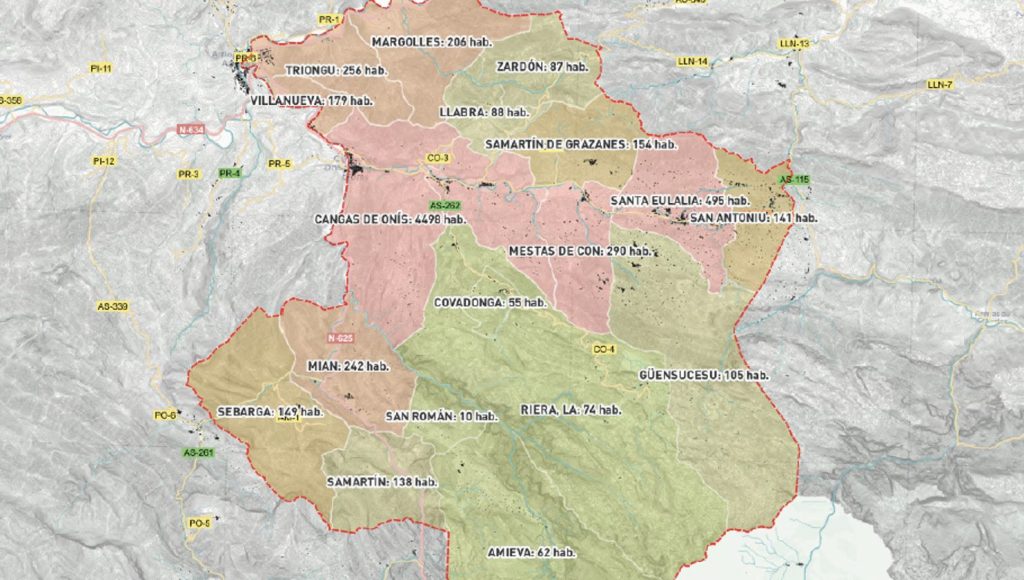 Parishes of the Mancomunidad with their population
In response, the plan proposes a battery of flexible, scalable measures adapted to the rural reality, which are divided into seven areas of action: daily mobility, cab network and transport on demand, interurban public transport, tourist mobility, infrastructures for sustainable mobility, school transport and educational accessibility. In particular, a series of actions are proposed to improve rural mobility in the Mancomunidad, taking into account all the particularities of the area under study, these measures are focused on these areas:
– Adapted and sustainable transport for the elderly
– School mobility for young people
– Regional cab system
– Public transport
– Parking and electric charging
– Regulation at tourist points
– Improvement of pedestrian connection between services in Amieva
Additionally, the Mobility Plan aims to establish a structured strategy to optimize transport and accessibility in the region, promoting sustainable and efficient solutions. For this purpose, different implementation phases have been defined, organized in time scenarios that allow a progressive and coordinated development of the actions. Three execution horizons are established according to the urgency and feasibility of the measures: short, medium and long term.